Convection ovens heat the air around your parts, so they cure complex shapes evenly but take longer. Infrared ovens heat the part surface directly with radiant energy, so they cure flat or simple parts quickly but need line of sight. Choose convection for variety and infrared for speed or heat-sensitive substrates.
Key Takeaways:
- Convection heats the air. Infrared heats the surface of the part directly.
- Convection suits mixed jobs with tubes, corners and deep recesses.
- Infrared suits flat, simple or heat-sensitive parts, but surfaces it can’t see stay under-cured.
- Either method must bring the part itself up to the powder’s cure temperature and hold it there.
- Many shops run both: convection for the main work and infrared for specialty jobs, pre-gel and spot curing.
You’ve got a part in the oven. Twenty-five minutes in, the wheel is cured but the inside of the bracket next to it is still soft. Or you’re pushing a flat panel through a big batch oven for 40 minutes when it could be done in a fraction of that.
Sound familiar? That’s the infrared versus convection decision, and it’s worth getting right before you buy an oven or add a second one. Here’s how each works, where each wins, and how to choose between them for your shop.
What is the difference between infrared and convection curing?
Convection curing circulates heated air around a part until the metal reaches cure temperature, which heats complex shapes evenly but slowly. Infrared curing uses radiant energy to heat the part surface directly, which is faster but depends on line of sight. Both methods must bring the coating to the temperature and time the powder manufacturer specifies. Your part mix decides which one fits.
How Convection Ovens Cure Powder
A convection oven uses burners or electric elements to heat air, then moves that air around the load with fans. The air warms the part’s surface, and the heat soaks inward until the metal itself hits cure temperature.
That’s why timing matters. Standard polyester powder cures at 375 to 400°F for 10 to 15 minutes, counted from the moment the part reaches that temperature. Total oven time often runs 25 to 45 minutes, because heavy parts take a while to catch up with the air.
Convection ovens come in a few forms in our catalog:
If you’re still sorting out the basics, our post on curing oven vs powder coat oven explains how the two terms differ.
How Infrared Ovens Cure Powder
Infrared heating skips the air. Emitters send radiant energy straight to the part’s surface, and the coating absorbs it. The part warms fast because you’re not heating a whole chamber first.
Our infrared (IR) specialty ovens include the Cerakure LP1, LP2, LP4 and LP6 catalytic IR curing ovens, plus the NANO Desktop IR oven for small parts. The category is built for coatings like Cerakote and for substrates such as wood, composites and medical parts. The page describes cure in about 20 minutes rather than hours for the coatings it targets.
There’s one catch, and it’s a big one. Infrared only heats what its emitters can see.
Infrared vs Convection at a Glance
|
Factor
|
Convection oven
|
Infrared oven
|
|
How it heats
|
Hot air circulates around the part
|
Radiant energy heats the surface directly
|
|
Best for
|
Mixed jobs, complex shapes, large batches
|
Flat or simple parts, specialty coatings
|
|
Heat-up speed
|
Slower, heats the air first
|
Faster, heats the part directly
|
|
Cure uniformity
|
Even across hidden surfaces
|
Depends on line of sight to every surface
|
|
Heat-sensitive parts
|
Can overheat the whole part
|
Can limit heat to what the coating needs
|
|
Typical shop role
|
Main production oven
|
Specialty, pre-gel or spot cure
|
Which Parts Suit Which Oven
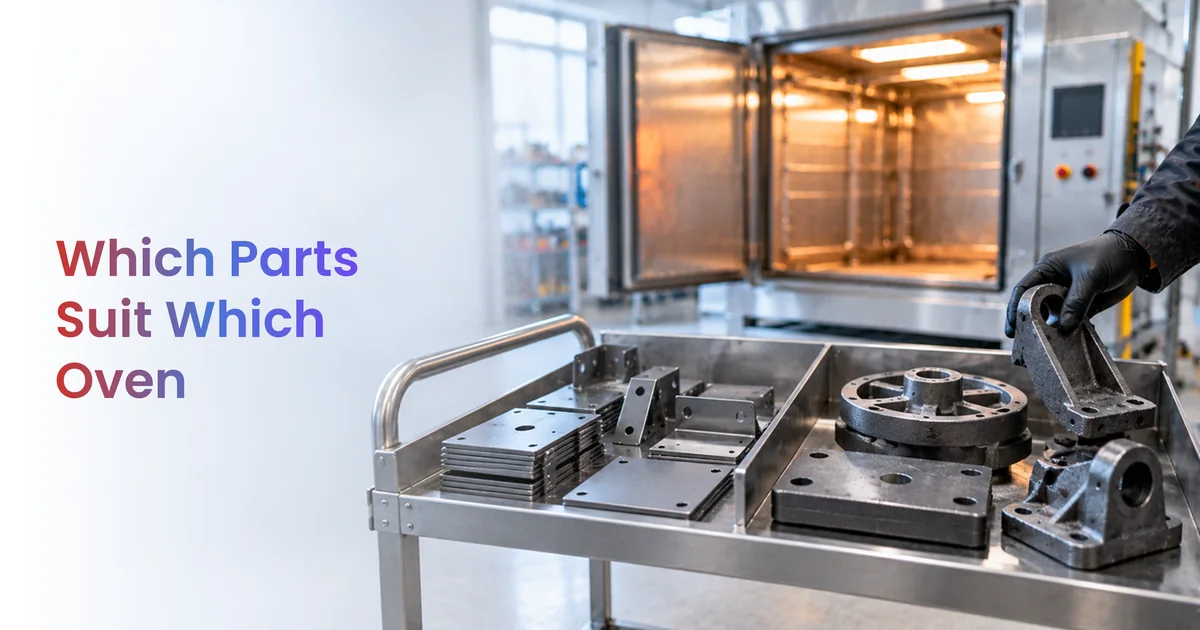
Convection is the safer choice for:
- Tubing, frames and parts with inside surfaces
- Wheels, brackets and assemblies with recesses
- Mixed batches with different shapes and thicknesses
- Large loads hung on racks
Infrared fits better for:
- Flat panels and sheet metal
- Small parts with simple geometry
- Wood, composites and other heat-sensitive substrates
- Thin-film and low-temperature coatings
- Quick turnaround jobs where oven heat-up time is the bottleneck
|
Not sure which oven fits the parts you coat most often?
Our team at Creative Coating Solutions helps shop owners match oven type and size to their part mix and coatings.
|
The Line-of-Sight Problem
Think of an infrared emitter like a lamp. Anything the light can’t reach stays cooler. Inside corners, the back of a bracket, the inside of a tube and areas shadowed by another part can all end up under-cured while the front face is done.
An under-cured coating looks fine at first, then fails. It scratches easily, softens with solvent and peels. If you see those symptoms, our guide to common powder coating defects and how to fix them walks through the causes.
Three ways shops handle line of sight:
- Choose simple parts. Flat and open shapes cure well under infrared.
- Rotate or reposition. Turn parts to expose every surface.
- Combine methods. Use infrared to gel the coating, then finish in a convection oven.
Whatever you pick, test with a thermocouple or a temperature probe on the part itself. The coating cares about metal temperature, not oven settings.
Heat-Sensitive Substrates and Specialty Coatings
Convection works by raising the part to temperature, so a part that can’t tolerate heat for 25 to 45 minutes has a problem. Wood, composites and some medical substrates fall into that group.
Infrared can help here. With the right emitters and coatings, it can deliver the heat the coating needs while limiting how long the substrate sits at temperature. Pair it with a low-temperature or specialty coating and you’ve got a workable process for parts convection can’t handle.
Always confirm the cure schedule with the coating supplier. Wavelength, distance and part color all change how a part absorbs infrared energy, so run test pieces before you commit production parts.
|
Coating wood, composites or other heat-sensitive parts?
Our team at Creative Coating Solutions helps you match infrared oven size and coating type to substrates that can’t handle a full convection cycle.
|
Portable Infrared Heaters: Pre-Gel and Spot Curing
Not every infrared job needs a full oven. Our infrared heaters page lists portable units for powder curing, pre-gelling and spot curing:
These suit spot repairs, pre-gelling parts before they enter a convection oven, and work cells where a full oven doesn’t make sense.
For the bigger picture of how ovens, booths, guns and air systems work together, read our guide to powder coating equipment: ovens, booths, guns and air systems explained.
How to Choose
Run through this list before you decide:
- Part shapes. Mostly tubes, frames and recesses points to convection. Mostly flat panels points to infrared.
- Substrate. Wood, composites and other heat-sensitive materials point to infrared.
- Part sizes. Measure your largest part and your typical batch.
- Coating type. Check the manufacturer’s cure schedule and any infrared guidance.
- Utilities. Match the oven to the electric or gas service you can install.
- Growth. If your part mix is changing, choose the oven that covers the widest range.
- A second oven. Many shops run convection as the workhorse and add infrared for specialty work.
Still weighing options? Our guide on how to choose a powder coat oven goes deeper on sizing and fuel type, and our post on choosing powder coating equipment for small and mid-size shops helps you decide where an oven fits in your overall setup.
|
Not sure whether infrared, convection or both fits your shop?
Our team at Creative Coating Solutions reviews your parts, coatings and utilities, then recommends the oven setup that fits. We help shops across the USA plan curing equipment around the work they run.
|
Conclusion
Convection and infrared solve different problems. Convection gives you even heat across any shape. Infrared gives you speed and a way to coat parts that can’t take a long oven cycle.
Pick based on your parts, your coatings and the substrates you run. Test with real parts and a temperature probe, and confirm the cure schedule with your powder supplier.
Ready to compare options? Browse our infrared (IR) specialty ovens and electric curing ovens, or talk to our team and we’ll help you match the oven to your work.
FAQs
What is the difference between infrared and convection ovens?
A convection oven heats the air around the part, while an infrared oven heats the part’s surface directly with radiant energy. Convection cures complex shapes evenly but slowly. Infrared heats faster but only reaches surfaces it can see, so it suits simpler parts.
Is infrared curing faster than convection?
Often, yes. Infrared heats the part directly, so there’s no wait for a chamber of air to heat up. The coating still has to reach its cure temperature and hold it for the required time. Test your parts and follow the powder manufacturer’s cure schedule.
Can you cure powder coating with infrared?
Yes, when the part and coating suit it. Infrared works best on flat or simple shapes where emitters can see every surface. Complex parts with hidden areas can end up under-cured, so many shops use infrared to gel the powder and finish in convection.
What is the line-of-sight problem with infrared ovens?
Infrared energy travels in straight lines, like light. Surfaces the emitters can’t see, such as inside corners, tube interiors and shaded areas, heat more slowly and may not fully cure. Repositioning parts, choosing simple shapes or finishing in a convection oven fixes the problem.
Which oven is better for powder coating, infrared or convection?
Convection suits most general shops, because it handles mixed shapes and large batches. Infrared suits flat parts, specialty coatings and heat-sensitive substrates. The better choice depends on your part mix, so many shops run convection as the main oven and add infrared later.
Can infrared ovens cure heat-sensitive materials like wood or composites?
Often, with the right setup. Infrared can deliver the heat a coating needs without holding the whole part at temperature for a long cycle. Always confirm the cure schedule with the coating supplier and run test pieces before production.
Do I still need a convection oven if I have an infrared oven?
It depends on your parts. If you coat tubes, frames or recessed shapes, you’ll want convection for even cure. If you only run flat or simple parts, infrared alone may be enough. Many shops keep both for flexibility.
How do I check that infrared cured the coating properly?
Measure the temperature of the part itself with a thermocouple or probe, and hold it for the cure time on the powder’s data sheet. Then check the coating with a solvent rub test or the manufacturer’s recommended test. Surface color alone doesn’t prove cure.