There's a moment every new shop owner hits. They've got the space, they've got the business plan, and they're staring at equipment catalogs, wondering where the hell to start.
I get it. Powder coating isn't a single-machine operation. You're piecing together a production system where the oven needs to match your booth capacity, your guns need clean air to function, and your prep equipment determines whether anything sticks in the first place.
Mess up one piece and the whole thing bottlenecks.
Let me walk you through what each major component actually does, why it matters, and what separates equipment that works from equipment that just takes up floor space.
Cure Ovens: The Heart of Your Operation
Here's the truth about powder coating ovens that equipment sellers don't always emphasize. Raw heating power matters way less than temperature consistency.
I've seen shops buy oversized ovens thinking bigger equals better, then struggle with finish quality because hot spots and cold zones create uneven cures. Meanwhile, a properly designed smaller oven is designed to produce flawless results because every part sees the same temperature throughout the cycle.
Batch ovens fit most job shops perfectly. Load your parts, close the door, run the cycle, and pull them out. Straightforward operation that handles the variety most custom shops deal with daily.
Conveyorized systems earn their keep when you're running enough volume to justify the complexity. Parts flow through continuously without stopping production. But they cost more, take more space, and need more maintenance.
What should actually drive your oven decision:
- Interior dimensions that handle your bread-and-butter work with room for occasional large jobs
- Even heat distribution-ask about temperature variance across the chamber
- How fast it recovers after you open the door
- Energy costs based on your actual production schedule
- Exhaust capacity that matches your powder types
Shop owners running powder coating equipment for sale through high-volume operations care about different specs than job shops coating twenty different parts per day. Know which category you fall into before you buy.
Check Out Our Products: Air Makeup Units for Booths – Ensure Clean, Balanced Airflow | Shop Now
Spray Booths: More Than a Box With Filters
A booth does two jobs at once. It captures overspray so you can reclaim and reuse powder. And it keeps airborne material from coating every surface in your building.
Both jobs matter. Skimp on either and you'll regret it.
Open-face designs give operators flexibility. You work from outside the booth while parts hang inside. Great for shops where part sizes change constantly and you need room to maneuver.
Enclosed booths trap powder more effectively. Higher reclaim rates mean lower material costs over time. Makes sense for production environments running steady work.
The features that actually affect your daily life:
- Airflow patterns that pull powder away from your people, not toward them
- Lighting good enough to see coverage on tricky geometries without squinting
- Filter capacity matched to your actual production volume
- Color change capability if you're not running single-color production
- Doors and openings sized for your real parts, not hypothetical ones
Shops doing automotive body repair or mixed fabrication work need different booth setups than dedicated production lines. Think about what you're actually coating before you commit.
Spray Guns: Where Skill Meets Technology
This is the powder coating tools category where operator talent intersects with equipment quality. A skilled coater with mediocre equipment outperforms a novice with top-shelf guns every time. But give that skilled operator proper tools and watch what happens.
Corona guns dominate the industry for good reason. They work. Electrical charge attracts powder to grounded metal parts with predictable results. Most general work goes through corona systems without issues.
Tribo guns solve specific problems. Those inside corners where powder won't reach? Recessed areas that come out thin? Tribo charging handles Faraday cage situations that frustrate corona systems. Not better overall, just better for certain geometries.
Smart shops stock both. Switching guns takes less time than fighting physics with the wrong tool.
Beyond the gun itself, your application setup includes:
- Hoppers that keep powder flowing without clumps
- Feed systems sized correctly for your guns
- Controllers delivering consistent output shift after shift
- Grounding equipment that actually works
That last point deserves emphasis. Bad grounding creates orange peel, light coverage, and wasted material. I've watched shops troubleshoot gun settings and powder chemistry for weeks when the real problem was a corroded ground clamp. Check your grounds first when problems appear.
Compressed Air: The System Nobody Thinks About Until It Fails
Air runs everything in a coating operation. Guns need it. Hoppers need it. Blast cabinets need it. Auto body workshop tools need it. And when that air carries moisture or oil, problems show up everywhere.
Compressor capacity starts with honest math. List every tool and system that runs simultaneously. Add those CFM requirements. Then add at least 25% because your operation will grow and you'll add equipment you haven't thought of yet.
Air quality separates professional finishes from amateur results. Moisture causes powder clumping, spitting, and weird texture issues. Oil contamination creates fish eyes, craters, and adhesion failures. These problems look like powder problems or technique problems until you trace them back to contaminated air.
What your air system needs:
- Moisture separation at the compressor before problems spread downstream.
- Proper drying equipment-refrigerated dryers work for most shops, desiccant systems for extreme requirements.
- Oil filtration if you're running lubricated compressors.
- Point-of-use filters protecting critical equipment.
- Regulators sized for actual flow, not just pressure.
Geography matters here. A shop in Phoenix deals with different air quality challenges than one in Houston. Humidity levels and temperature swings affect what drying equipment you need.
Explore Our Collection: Discover High-Performance Professional Paint Booth Systems
Surface Prep: The Step That Makes Everything Else Work
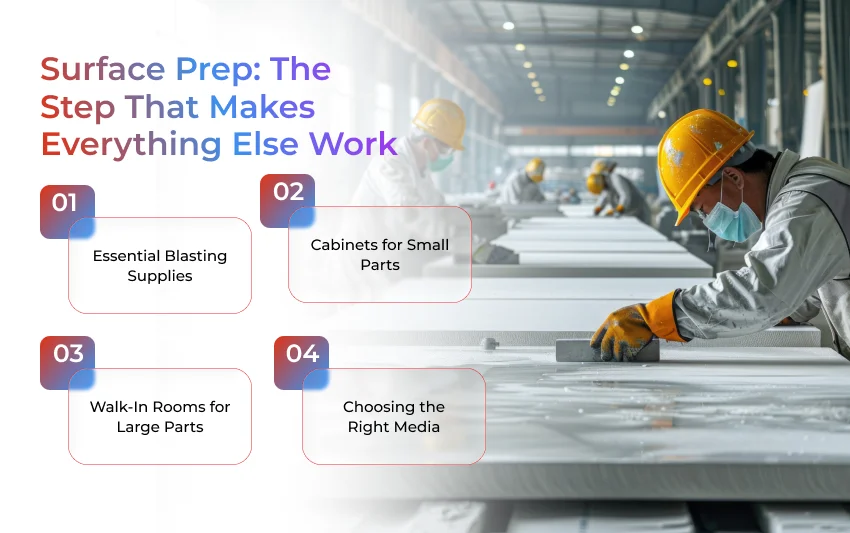
Ask any veteran coater what matters most for finish quality. They'll tell you surface preparation-always. It’s the foundation of a flawless powder coating job.
Essential Blasting Supplies
Abrasive blasting supplies and prep equipment might be the least glamorous purchases you make, but they are among the most important. The right tools ensure the coating adheres properly and lasts longer.
Cabinets for Small Parts
Blast cabinets are perfect for detail work and smaller parts.
- Bench units serve occasional or hobby-level needs.
- Floor-standing cabinets with dust collection and media reclaim support steady, high-volume production.
Walk-In Rooms for Large Parts
When part size exceeds cabinet capacity, walk-in blast rooms become necessary. They accommodate:
- Large fabrications
- Structural steel
- Heavy equipment
Choosing the Right Media
Media selection affects both your surface profile and operating costs:
- Aluminum oxide – Aggressive cutting action for tough surfaces
- Glass bead – Cleans and peens without heavy material removal
- Steel grit – Handles serious scale and corrosion
- Garnet – General-purpose work without breaking budgets
Different substrates and coating requirements demand different media types. Stocking multiple options ensures you can tackle any job efficiently.
Putting the Pieces Together
Individual equipment performs best when everything works as a system. Your booth airflow affects overspray throughout your shop. Oven throughput limits how fast your line can run. Air capacity determines how many operators work simultaneously.
Shops that grow by adding equipment piecemeal sometimes create bottlenecks without realizing it. Faster guns accomplish nothing if parts stack up waiting for oven space.
Before buying or upgrading, think through:
- Where your current operation actually slows down
- How much growth you planning over the next three to five years
- Whether your utilities can handle additional equipment
- Where new equipment physically fits in your workflow
- What maintenance capacity you have for more complex systems
Upgrade Your Spray Booth Without Guesswork
The right booth reduces material waste, speeds up color changes, and keeps your shop clean. Explore professional spray booth systems built for real production needs.
|
Ready to Build or Upgrade Your Operation?
Understanding how ovens, booths, guns, and air systems work together puts you ahead of shop owners who buy equipment in isolation and wonder why production struggles.
Creative Coating Solutions is a U.S. veteran-owned supplier serving powder coating, abrasive blasting, and metal finishing shops across the country. We stock professional finishing equipment, cure ovens, spray booths, application systems, blast cabinets, and the daily consumables that keep production moving. Whether you're planning a new shop or upgrading an existing operation, we understand what these systems need to work right.
Planning equipment purchases or looking to fill gaps in your current setup? Browse our inventory and request a quote. We'll help you figure out what fits your shop and your production reality.
FAQs
What oven size works for most powder coating job shops?
+
A 6x6x8 foot batch oven handles the majority of custom job shop work, accommodating most automotive, architectural, and industrial parts. Shops processing larger items like truck frames or patio furniture need 8x8x10 feet or larger. Match usable interior dimensions to your largest part plus racking clearance of at least 6 inches on all sides.
How much compressed air does a powder coating operation really need?
+
Most powder coating guns require 10–15 CFM at 40–60 PSI at the applicator. Factor in simultaneous booth ventilation, pretreatment rinse, and blasting operations when sizing your compressor. A refrigerated dryer maintaining dew points below 35°F is required to prevent moisture-related adhesion failures. Total system demand typically runs 30–60 CFM for a single-booth shop.
What is the difference between a corona and a tribo powder coating gun?
+
Corona guns apply an electrostatic charge at the gun tip and work well for most flat surfaces and standard powder chemistries. Tribo guns generate charge through friction inside the barrel and deliver superior penetration into recessed areas and complex geometries where Faraday cage effects reduce coverage. Most high-mix shops benefit from having both types available.
How much does a complete powder coating equipment setup cost?
+
A functional starter powder coating setup — including a batch oven, spray booth, gun system, and compressor — typically ranges from $15,000 to $50,000 depending on size and quality tier. Professional-grade setups for mid-volume shops run $50,000 to $150,000. Financing options are available through equipment lenders, and the 100% bonus depreciation provision allows full first-year write-off for qualifying purchases.
What is the correct airflow velocity for a powder coating spray booth?
+
The minimum recommended face velocity for a powder coating spray booth is 100 feet per minute (FPM) to contain overspray and meet worker safety standards. Enclosed cartridge-filter booths should maintain this velocity at the filter face. Booths exceeding building infiltration capacity require a dedicated air makeup unit to maintain correct negative pressure and prevent cross-contamination.
What causes uneven curing or finish defects in powder coating?
+
Uneven curing is most commonly caused by poor oven temperature uniformity — temperature swings exceeding ±15°F across the chamber produce inconsistent film properties. Other causes include contaminated compressed air (oil or moisture), insufficient powder charging due to worn gun components, and inadequate surface prep leaving residual oils or oxides. Regular calibration with a multi-point data logger prevents most oven-related defects.
Can one spray booth handle frequent color changes efficiently?
+
Yes, but booth design determines how efficiently. Enclosed booths with cartridge filter systems allow rapid color changes by blowing down filters and purging residual powder before switching. Open-face booths with rolled polyethylene liner systems speed clean-up but require more manual labor per change. Dedicated single-color booths are the most efficient approach for high-volume operations running three or fewer colors.