A curing oven and a powder coat oven are the same type of equipment. The terms are used interchangeably across the industry. Both describe a convection oven that heats parts to 325-450°F to melt and chemically bond dry powder to metal. What actually differs is the fuel type (electric vs gas), the chamber size, the temperature uniformity rating, and whether the oven is sized for your part dimensions and production volume.
Key Takeaways
- A curing oven and a powder coat oven are the same thing. The names are interchangeable across the finishing industry.
- Powder coating cures at 325-450°F depending on the powder type, and the cure clock starts when the metal part itself reaches target temperature, not when the oven air does.
- Electric curing ovens suit shops running 4-6 hours per day or less. Gas-fired ovens cost less to operate at high production volumes and recover heat faster after door openings.
- Temperature uniformity of plus or minus 10°F is the standard for most powder coating work. Tighter specs cost more and are only needed for specialty coatings.
- Creative Coating Solutions carries electric and gas curing ovens from compact 4x4x4-foot configurations to large industrial walk-in models for shops across the USA.
You're shopping for an oven for your powder coating setup, and you keep seeing two different terms used for what looks like the same piece of equipment.
Curing oven. Powder coat oven. Are they different products? Do you need to buy one specific type? Will you mess up your finish if you buy the wrong one?
Here's the short answer: you won't. Because they're the same thing.
But that's not the whole story. What matters after you get past the naming confusion is understanding what makes one oven actually work for your shop while another one causes headaches. Temperature uniformity, fuel type, chamber size, BTU output, airflow design, and temperature range all affect whether your parts come out right or end up getting recoated.
Shops across the USA ask us about this constantly. So we're going to settle the terminology question in about two minutes, then spend the rest of this guide on the things that actually matter for your buying decision.
What is a curing oven for powder coating?
A curing oven for powder coating is an industrial convection oven that heats powder-coated metal parts to 325-450°F until the powder melts, flows out, and chemically cross-links into a hard, durable finish. The oven must maintain consistent temperature throughout the chamber so every part in the load reaches the same metal temperature for the correct amount of time. Both electric and gas-fired models accomplish this, with the main practical differences being operating cost, heat recovery speed, and installation requirements.
Curing Oven vs Powder Coat Oven: Settling the Terminology
Let's clear this up right away because the confusion costs people time when they're shopping.
A curing oven, a powder coat oven, a powder coating oven, a powder curing oven, a paint curing oven, a batch curing oven. These are all names for the same category of equipment. Different manufacturers and different shops use different terms, but they're describing the same basic machine: a convection oven that gets hot enough to cure a coating on a metal part.
The reason multiple names exist is partly industry habit and partly because the same type of oven gets used for multiple coatings, not just powder. Shops that cure wet paint, epoxy, Cerakote, or other industrial coatings use a curing oven. Shops that only do powder coating call it a powder coat oven. The hardware itself isn't fundamentally different between them.
Where real differences show up is in the specs: temperature range, uniformity, fuel type, airflow design, and chamber size. Those differences matter for your application. The name on the product listing doesn't.
So when you're comparing products labeled "powder coat oven" vs "curing oven" and wondering if you're looking at different things, you're not. Focus on the specs, not the label.
Read More: Common Powder Coating Defects and How to Fix Them
Is a curing oven the same as a powder coat oven?
Yes. A curing oven and a powder coat oven are the same type of equipment. Both describe a convection oven used to heat-cure coatings on metal parts. Different manufacturers and shops use different terminology for the same product category. The practical differences between models are in temperature range, uniformity, fuel type, chamber size, and airflow, not in whether the product is called a curing oven vs a powder coat oven.
How the Curing Process Actually Works (Most Shops Get This Wrong)
This is the part that trips up a lot of shops, especially ones getting started with powder coating. And getting it wrong means under-cured parts that chip, peel, or fail adhesion.
Here's what's actually happening inside the oven when you cure powder coating.
Powder starts to melt and flow out around 300°F. You'll see the dusty, matte-looking powder layer transform into a smooth, glossy film. But melting is not the same as curing.
Full cure, meaning the chemical cross-linking that gives the finish its durability and adhesion, requires the metal part itself to reach the manufacturer's specified temperature and stay there for the stated time. Most standard polyester powders require the metal to hit 400°F and stay there for 10-15 minutes, according to Reliant Finishing Systems' cure schedule data.
Here's the critical point most beginners miss: the cure clock starts when the metal part temperature (PMT - part metal temperature) hits the target. Not when the oven air hits it. Not when you close the door. When the metal itself is there.
A thin bracket made of sheet steel might reach 400°F in 3-4 minutes after the oven recovers. A heavy alloy wheel or a thick steel frame might take 20-30 minutes just to soak up to temperature before the cure clock even starts. If you're timing your cure from when you close the oven door, you may be pulling parts before they're actually done.
Your total oven time equals the heat-up and soak time for the part to reach target PMT, plus the dwell time specified by the powder manufacturer. For most moderately heavy parts in a properly sized batch oven, that total runs 25-45 minutes per load, according to data from Reliant Finishing Systems.
Different powder types also have different cure requirements:
Powder Type
|
Cure Temperature
|
Dwell Time at PMT
|
Standard polyester
|
375-400°F
|
10-15 minutes
|
Low-bake polyester
|
325-350°F
|
20-25 minutes
|
Urethane / hybrid
|
375-390°F
|
10-12 minutes
|
Epoxy
|
350-375°F
|
10-12 minutes
|
High temperature
|
Up to 450°F
|
Per manufacturer spec
|
Always pull the Technical Data Sheet for your specific powder. The cure schedule on the TDS is what you follow, not a generic "20 minutes at 400°F" rule that's become shop folklore.
What temperature does a curing oven need to reach for powder coating?
Most powder coating cures at 325-450°F depending on the powder type. Standard polyester, the most common powder used in shops across the USA, cures at 375-400°F. The temperature must be held at the part metal itself, not just the oven air, for the dwell time specified on the powder's Technical Data Sheet. Most industrial curing ovens are rated to 500°F maximum, which gives adequate headroom above standard cure temperatures.
Electric vs Gas Curing Oven: The Real Cost Difference
This is the second most common question we get after the naming question. And the answer is more nuanced than "gas is better."
Both electric and gas ovens produce the same result on the part. The powder doesn't know whether the heat came from resistance elements or a gas burner. What differs is operating cost, installation complexity, and heat recovery behavior.
Electric powder coating ovens
Electric curing ovens use resistance heating elements inside the chamber. They're cleaner to install because you don't need gas lines or a licensed mechanical contractor. You wire them in, set your PID controller, and run.
Electric ovens also offer finer temperature control. The heating elements respond quickly to the PID, which makes them well-suited for specialty powders that have tight temperature windows.
The operating cost of electric ovens is higher than gas in most parts of the USA when you're running at production volumes. For a shop running 4-6 hours per day on light to moderate loads, the difference in monthly energy cost is manageable. For a shop running 8-12 hours per day, it starts adding up fast over a full year.
Creative Coating Solutions carries electric powder coat ovens in multiple configurations, from compact models suited for small shops through to larger production walk-in units. All are built and tested before shipping to shops across the USA.
Gas-fired curing ovens
Gas curing ovens use direct-fired or indirect-fired burners. They heat up faster from cold, recover temperature faster after door openings, and cost less per hour to operate at sustained production volumes.
The 8x8x15-foot gas-fired curing oven in the Creative Coating Solutions lineup runs dual 50,000-275,000 BTU burners and meets Class A safety requirements, including high and low gas pressure interlocks, circulation interlocks, exhaust interlocks, and explosion-compliant door latches. Gas ovens require a licensed mechanical contractor for installation and commissioning.
The practical guide:
- Running under 6 hours per day or getting started: electric makes sense
- Running 6+ hours per day consistently, with existing gas infrastructure: gas saves money over time
- No gas infrastructure at your facility: electric is the simpler starting point regardless of volume
Is an electric or gas curing oven better for powder coating?
Neither is universally better. Electric ovens are simpler to install, offer precise temperature control, and suit shops running shorter production days or specialty powders. Gas ovens heat faster, recover quicker after door openings, and cost less to operate at sustained high-volume production. For shops running 6 or more hours per day in the USA, gas typically shows a clear cost advantage over 12-18 months. For lower-volume shops or those without existing gas lines, electric is the practical starting point.
Also Worth Knowing: Your curing oven throughput needs to match your powder spray booth capacity. If your booth applies powder faster than your oven cures it, parts queue up and your workflow stalls. See how Creative Coating Solutions matches powder spray booths to oven output. View booth options
Read More: Powder Coating Ovens: Why Custom Sizes Boost Your Production
Temperature Uniformity: The Spec Most Buyers Skip
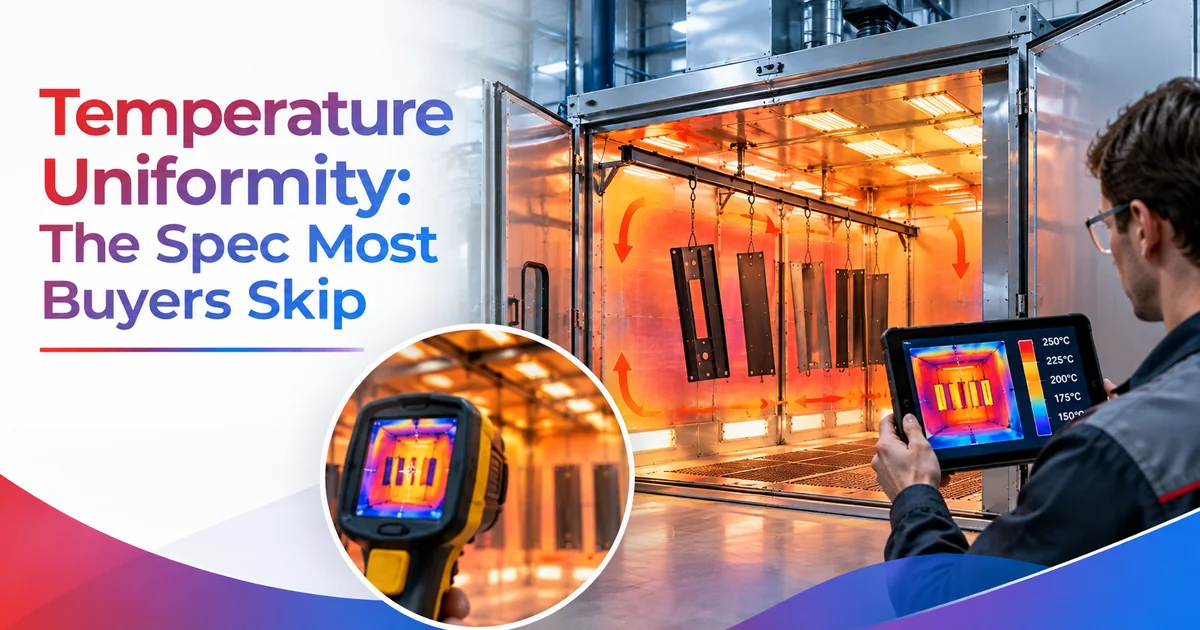
Here's the curing oven spec that gets glossed over in most buying conversations but directly affects your finish quality on every single load.
Temperature uniformity tells you how closely the air temperature across the entire oven chamber matches your target temperature. A oven rated at plus or minus 10°F means some zones in the chamber run 10 degrees hotter than your setpoint and some run 10 degrees cooler.
Why does that matter? Your powder manufacturer's cure schedule says 400°F for 12 minutes. If zones in your oven only reach 390°F, parts in those zones are under-cured. The cross-linking never fully completes. The finish looks fine coming out of the oven, then chips or peels in service two months later.
On the other end, zones running at 410°F can over-cure your powder. On lighter colors, especially whites, over-baking causes yellowing and can make the film brittle.
Here's what the industry recommends according to Wisconsin Oven's technical guidelines:
- Plus or minus 10°F: Acceptable for most standard powder coating and wet paint applications
- Plus or minus 5°F: Required for Cerakote, aerospace coatings, and specialty high-performance finishes
For most shops across the USA doing general powder coating work on steel and aluminum, a plus or minus 10°F uniformity rating is what you need to hit. Don't pay for tighter specs you don't need, but don't buy an oven that can't hit plus or minus 10°F and expect consistent results.
What drives temperature uniformity in a curing oven?
- Airflow design and fan placement inside the chamber
- Insulation quality and panel thickness
- Door seal integrity
- Element or burner placement relative to parts
- How fully the oven is loaded per batch
An over-packed oven has parts blocking airflow, creating cold spots that show up in your finish. An under-loaded oven wastes energy but typically gives you better uniformity on the parts you do run.
How to Size a Curing Oven for Your Shop
Sizing mistakes cost more than the oven itself over time. Too small and you're splitting batches, running extra cycles, and slowing your whole production down. Too large and you're heating a box that's mostly empty, which wastes energy every hour you run.
Work through these questions before you order:
What are your three largest regular parts?
Measure length, width, and height. Add 6-12 inches of clearance on all sides for airflow. That gives you your minimum interior working dimension.
How many parts do you cure per shift?
This tells you whether you need a batch oven for cycling loads through in groups, or whether a conveyor oven makes more sense for continuous production runs.
What's your heating fuel situation?
Do you have gas infrastructure at your facility? What's your available amperage for electric? The answers affect which fuel type is practical.
How heavy are your parts on average?
Heavier parts need more BTU or wattage to reach cure temperature in a reasonable time. Your oven's heating capacity in BTU or kW needs to match your typical batch weight, not just the chamber volume.
Are you planning to grow production in the next two years?
If you expect volume to increase significantly, sizing slightly ahead of current needs costs less than replacing the oven again in 18 months.
Creative Coating Solutions carries powder coating curing ovens in electric and gas configurations from compact 4x4x4-foot models through to large industrial walk-in and production ovens. Call (618) 741-0740 or email scott@creativecoatingsolutions.com to get a recommendation based on your actual part dimensions and daily volume.
What size curing oven do I need for my powder coating shop?
Size your curing oven so your largest regular part fits inside with at least 6-12 inches of clearance on all sides for proper airflow. For small parts and low volume under 50 parts per day, compact electric models from 4x4x4 to 4x4x7 foot work well. For mixed part sizes and moderate production, a larger batch oven in the 6x6 to 8x8 foot range handles most shop work. Shops running 200+ parts per day or parts exceeding 6 feet in length need larger walk-in configurations or conveyor systems.
What Else Can a Curing Oven Cure?
This question comes up a lot from shops that want to run more than one coating type through the same oven.
The good news: yes, the same industrial curing oven can handle multiple coating types. Just not at the same time.
According to Products Finishing magazine, you can cure powder coating and liquid paint in the same oven at different times, as long as the oven has the temperature range to handle both and adequate exhaust capacity for liquid coatings. Powder generally needs 350-450°F. Many liquid industrial paints and enamels cure between 250-400°F, so the temperature overlap makes it workable.
A few practical considerations if you're running multiple coating types:
Keep the oven clean between processes. Residual powder contamination in the oven can create defects in liquid paint finishes. If you're running both regularly, a cleaning schedule matters.
Exhaust requirements differ. Liquid coatings release solvent vapors during cure that need to be exhausted. Powder coating releases very little. If you're adding liquid paint to your process, confirm your oven's exhaust capacity covers both.
Cerakote cures similarly to powder. Cerakote typically cures at 250-300°F, which is lower than standard powder coating. The same industrial curing oven handles both, but you'll want precise temperature control at the lower range, which is another argument for a PID-controlled electric model if Cerakote is part of your work.
High-temperature powders need the full range. Exhaust pipes, engine components, and other high-heat parts often use specialty powders rated for operating temperatures above standard cure temps. Most industrial curing ovens rated to 500°F handle these without issue.
Not sure which curing oven configuration fits your shop's part mix, production volume, and fuel setup?
Our team puts together oven recommendations for shops across the USA based on your specific coating process and daily workload.
|
Wrap Up
The curing oven vs powder coat oven question has a simple answer: they're the same thing, just different names for the same equipment category.
What actually matters for your buying decision is getting the specs right. Temperature range rated to at least 450°F. Uniformity of plus or minus 10°F for standard powder work. Fuel type matched to your production volume and facility infrastructure. Chamber size based on your largest parts with proper airflow clearance. And BTU or kW capacity sized to your typical batch weight, not just the chamber volume.
And the curing process itself matters as much as the oven. The cure clock starts when the metal part hits target temperature. Not the oven air. Not the dial. The metal. Getting that right prevents under-cured parts that look fine coming out and fail in service two months later.
Creative Coating Solutions stocks electric and gas powder coating curing ovens for shops of every size across the USA, from compact 4x4x4-foot electric models to large industrial gas-fired production ovens.
FAQs
Is a curing oven and a powder coat oven the same thing?
Yes, completely. A curing oven and a powder coat oven describe the same category of equipment. Both are industrial convection ovens used to heat-cure coatings on metal parts at temperatures between 325 and 450 degrees Fahrenheit. The different names come from industry habit and from the fact that the same oven type handles powder coating, liquid paint, epoxy, Cerakote, and other coatings. When comparing products, focus on temperature range, uniformity, fuel type, and chamber size, not on what the manufacturer calls it.
What temperature does a powder coating curing oven need to reach?
Most standard polyester powder coating cures at 375-400°F at the part metal surface. Low-bake powders cure at 325-350°F. Urethane and hybrid powders typically cure at 375-390°F. High-temperature specialty powders may require up to 450°F. Always follow the cure schedule on your powder's Technical Data Sheet, and remember the cure clock starts when the metal part itself reaches the target temperature, not when the oven air does.
Does Creative Coating Solutions sell curing ovens across the USA?
Yes. Creative Coating Solutions is a veteran-owned supplier based in Fenton, Missouri that carries electric and gas powder coating curing ovens in multiple configurations for shops across the USA. From compact 4x4x4-foot electric models through to large industrial gas-fired walk-in ovens, they stock options for small shops through production operations. Call (618) 741-0740 or email scott@creativecoatingsolutions.com for specs and availability.
Can you use a regular household oven for powder coating?
Not reliably for commercial or serious hobby work. Household ovens don't reach the temperatures needed for full cure on most powders, don't have the uniformity required for consistent results, and create cross-contamination issues between food and coating chemicals. A dedicated industrial or hobbyist powder coat curing oven gives you proper temperature range, PID control for consistent cure schedules, and a chamber that's safe to use exclusively for coating.
How long does it take to cure powder coating in a curing oven?
Total oven time depends on part weight and the powder's cure schedule. Standard polyester powder needs 10-15 minutes of dwell time at part metal temperature of 375-400°F. But you also need to account for the time it takes the part to reach that temperature after the oven recovers. For moderately heavy steel parts in a properly sized batch oven, total oven time typically runs 25-45 minutes per load. Heavier parts take longer to soak up to temperature and extend total cycle time.
What's the difference between an electric and gas powder coat oven?
Electric curing ovens use resistance elements, are simpler to install without gas lines, offer precise temperature control, and suit shops running shorter production days. Gas curing ovens use burners, heat up faster, recover temperature more quickly after door openings, and cost less per hour to operate at sustained production volumes. For shops running 6 or more hours per day across the USA, gas typically shows a clear energy cost advantage over time. For shops running lower volume or without gas infrastructure, electric is the practical starting point.
Why is my powder coating peeling or chipping after curing?
Peeling after curing almost always means under-cure. The part didn't reach the target metal temperature, didn't stay there long enough, or both. Common causes are timing from when the oven air reaches temperature instead of when the metal does, pulling parts too early, or an oven with poor temperature uniformity where some zones don't reach the target temp. Check your powder's TDS for the exact cure schedule, use an infrared thermometer to verify part metal temperature during the cure cycle, and confirm your oven's temperature uniformity across the full chamber.
Can I cure powder coating and liquid paint in the same oven?
Yes, at different times, not simultaneously. You need an oven with a temperature range that covers both processes, typically up to 400-450°F for powder and as low as 250°F for some liquid coatings. You also need adequate exhaust capacity for the solvent vapors liquid coatings release during cure, which is a higher exhaust requirement than powder coating. Keep the oven clean between coating types to prevent contamination affecting your finish quality.