A powder coating batch oven that cannot hold a consistent temperature across its full interior will produce inconsistent finishes regardless of powder quality or surface preparation. Oven performance is the single variable that production shops can least afford to get wrong.
Most shops focus on oven interior dimensions when shopping for a paint curing oven. That's the right starting point, but it's only one of four specifications that actually govern coating quality: interior volume, temperature uniformity, BTU output relative to load mass, and airflow distribution through the cure zone.
This article covers how each of these specifications connects to daily finish quality, what numbers to look for in electric and gas curing ovens on the market, and how to calculate the minimum oven size your shop actually needs based on your part geometry and production volume.
Key Takeaways
- Temperature uniformity within plus or minus 5 degrees Fahrenheit across the full chamber is the specification that most directly predicts consistent daily finish quality
- Oven interior volume should be sized at 2.5 to 3 times the volume of your largest typical part to allow adequate hang spacing and airflow circulation
- BTU output must be matched to both chamber volume and maximum expected part load mass, not just interior dimensions alone
- A production curing oven that takes more than 15 minutes to recover set point after loading a cold batch creates a serious production bottleneck at production scale
- Large powder coating ovens over 8 feet in any dimension require recirculating fan CFM calculations that most spec sheets do not explicitly list
- Industrial curing oven construction quality at door seals, wall panel insulation, and heating element mounting points directly determines long-term temperature stability
Why Oven Size and Uniformity Determine Coating Quality
Powder cure chemistry requires three specific conditions: correct temperature, consistent temperature across all surfaces of the coated part, and sufficient dwell time at that temperature for full cross-link development. Oven design either enables or prevents all three simultaneously.
An industrial curing oven that runs hot in the front and cool in the rear creates a simple problem with costly consequences. Parts positioned near the heating elements may reach full cure specification, while parts at the back of the same load remain 30 degrees below the required cure temperature throughout the cycle.
"I get calls every week from shops running rejection rates of 8 to 12 percent on finish quality. When we trace it back, the oven uniformity is almost always the culprit. They're curing different parts of their load at different temperatures and blaming the powder." -
Scott Keyes, Creative Coating Solutions
According to the Powder Coating Institute, oven temperature uniformity failures account for 58% of adhesion-related field returns in production coating environments, making it the most costly single equipment specification when ignored or misunderstood.
Understanding why uniformity degrades inside a powder coating batch oven requires looking at two interacting systems: heat source placement and airflow distribution. Every uniformity problem traces back to one or both of these factors in the specific oven design.
Recirculating fans move heated air through the chamber and equalize temperature across the load. Inadequate fan CFM for the chamber volume creates stagnant zones. Poorly positioned heating elements create hot spots that fans cannot fully correct, regardless of CFM rating.
How to Size a Powder Coating Batch Oven for Your Parts
The minimum interior dimensions of a batch oven must exceed your largest typical part's envelope dimensions by enough margin to allow proper hang spacing and unobstructed airflow around the part surfaces. The general rule is interior volume is at least 2.5 to 3 times the total volume occupied by a maximum density part load.
For a shop processing parts up to 36 inches long, 24 inches wide, and 18 inches tall, the oven interior needs to be at least 48 to 54 inches long, 36 to 40 inches wide, and 36 to 42 inches tall to accommodate hang points, hook clearance, and adequate airflow margins around all surfaces.
Door opening dimensions deserve equal attention and are frequently overlooked. An oven with a 48-inch interior width paired with a 42-inch door opening means your largest parts must fit through a 42-inch opening before they can use the full interior. Verify actual door clearance dimensions, not just interior volume.
How Part Mass Affects Oven Sizing
Part mass affects thermal recovery time after loading. A large powder coating oven loaded with 200 lbs of steel takes 40 to 60 percent longer to return to the cure set point than the same oven loaded with 50 lbs of aluminum sheet. That recovery time is lost production time.
Calculate the thermal load: mass times specific heat times required temperature rise from ambient to cure temperature. For steel at 0.12 BTU/lb/°F, a 200 lb load heated from 70°F to 400°F requires 330°F rise times 200 lbs times 0.12 = 7,920 BTU minimum heat input before the oven can even begin the cure dwell period.
Find the Right Oven Size for Your Shop
Browse our full range of electric and gas curing ovens with detailed interior dimensions and BTU specifications.
|
Temperature Uniformity: What the Spec Means in Practice
Temperature uniformity specification describes the maximum deviation from the set point at any measured location inside the chamber during steady-state operation with a standard test load. Industrial curing oven standards use the American Institute for Baking (AIB) or equivalent test methods with thermocouples at a minimum of nine chamber positions. Products Finishing Magazine has documented cases where ovens set at 450 degrees Fahrenheit showed internal readings ranging from 300 to 450 degrees, with root causes traced to burner sizing and recirculation duct design.
A well-constructed powder coating curing oven achieves plus or minus 5 degrees Fahrenheit uniformity at all nine test positions. Budget units often show a variance of 15 to 25 degrees. The consequences of that variance scale directly with the tightness of the powder chemistry cure window.
Most thermoset powder formulations have a specified cure window of 350 to 400 degrees Fahrenheit at peak metal temperature. That's a 50-degree usable range. A 20-degree oven variance consumes 40% of that window before the operator has made any other decisions.
Testing Uniformity in a Used or New Oven
Testing uniformity yourself requires a multi-channel thermocouple recorder and a minimum of nine type K thermocouple probes positioned at the front-center, rear-center, top-center, bottom-center, and four corner positions, plus the geometric center of the chamber.
Run the test at your standard cure set point with a representative load in place. Record temperatures at 5-minute intervals for 30 minutes after the oven reaches the set point. Calculate the maximum deviation across all nine positions over that period. This is your real uniformity spec, not the number on the sales sheet.
Read More About: Powder Coating Equipment Explained: Ovens, Booths, Guns, and Air Systems
What BTU Output Actually Tells You About Oven Performance
The BTU output specification tells you the maximum heat input rate of the oven's heating system, whether electric elements in kW (multiply by 3,412 to convert to BTU/hr) or gas burner BTU/hr rating. It does not directly tell you how quickly the oven recovers from a cold load or how well it maintains the set point under continuous production conditions.
Recovery time matters in production because it directly determines how many cure cycles you can run per shift. An oven that takes 25 minutes to recover set point after each cold load versus one that recovers in 12 minutes produces 20 to 25% more cycles per 8-hour shift at equivalent cure dwell times.
The relationship between BTU output and recovery time depends on insulation quality, oven mass, and heat transfer efficiency. A well-insulated industrial curing oven with 90,000 BTU/hr output recovers faster than a poorly insulated unit rated at 120,000 BTU/hr because it loses less heat through walls during the recovery cycle. Wisconsin Oven recommends a recirculation rate of 3 to 4 air turnovers per minute as a minimum baseline for maintaining uniform temperature distribution across the full cure zone.
"Shops size ovens by interior dimensions and then wonder why their cycle times don't match the spec sheet. BTU output determines recovery rate. Recovery rate is what actually limits how many batches you can run in a day." -
Dave Hartley, Production Equipment Consultant, Products Finishing Magazine
Electric vs. Gas Heat Sources
Electric elements provide highly controllable heat input and eliminate combustion byproducts in the cure environment. They work well for facilities without existing gas service and for shops coating chemistries sensitive to combustion contaminants that can affect surface quality.
Gas burners deliver higher BTU output at lower operating cost per BTU in most US markets. Natural gas curing ovens are the standard choice for large powder coating ovens above 6 x 6 x 8 feet, where the operating cost advantage of gas over electric becomes substantial at production run rates.
How Dwell Time and Cure Cycle Affect Finish Consistency
Dwell time is the period during which the part surface maintains cure temperature, not the period the oven runs at the set point. The distinction matters because mass, substrate conductivity, and load density all affect how quickly part surfaces reach the temperature the oven air is maintaining.
Standard cure specifications on powder data sheets state time at peak metal temperature (PMT), typically 10 to 20 minutes at 350 to 400 degrees Fahrenheit, depending on powder chemistry. Operators who time their cure from when the oven reaches the set point, rather than when part surfaces reach PMT, systematically undercure heavy-gauge parts and dense loads.
A contact pyrometer measures PMT directly. For shops running consistent part geometries, a one-time PMT measurement at multiple load positions establishes the lag time between oven air temperature and part surface temperature. Build that lag time into your standard cycle settings permanently.
Overcure: The Opposite Problem
Overcure from excessive dwell time or temperature has its own failure mode: pigment degradation, gloss reduction, and in severe cases, polymer chain breakdown that compromises mechanical properties. Metallic and bright pigments are particularly vulnerable to overcure and show visible color shift at temperatures 20 to 30 degrees above specification.
Get the Oven Specifications Right the First Time
Call Scott at (618) 741-0740 for direct technical help matching oven BTU, size, and uniformity specs to your shop's requirements.
|
Powder Coating Oven Considerations for Production Shops
Large powder coating ovens above 6 x 6 x 8 feet interior dimensions introduce engineering considerations that smaller batch units do not require. Structural support for internal fixtures, door counterbalance systems, and gas line sizing all require specific attention at these dimensions.
Recirculating fan sizing becomes critical at large volumes. The industry standard for uniform temperature distribution in production batch ovens is one air change per minute based on chamber volume. A 288 cubic foot chamber (6 x 6 x 8) requires a minimum of 288 CFM fan capacity for adequate circulation, with most production-grade units specifying 400 to 500 CFM at this volume to provide margin.
Door design on large units affects both uniformity and production efficiency. Multi-panel doors, vertical lift doors, and bi-fold doors each have different seal quality characteristics and operational characteristics that affect daily workflow in high-volume production environments.
Gas supply sizing for large gas-fired industrial curing ovens requires a dedicated gas line sized for the burner's full BTU demand at operating pressure. A 250,000 BTU/hr burner at 0.5 inch water column operating pressure requires a significantly different supply line than the gas connections running your other shop equipment.
Electrical Service for Large Electric Ovens
Large electric curing ovens above 40 kW (136,000 BTU equivalent) typically require 480V three-phase service. If your shop currently operates on 240V single-phase power, verify your electrical panel capacity before specifying a large electric unit. The service upgrade cost should be factored into the total equipment investment calculation upfront.
Curing Oven Features That Separate Good From Poor Quality
The build quality features that separate reliable industrial curing ovens from budget units show up in construction details that don't appear prominently in spec sheets. These features determine how consistently the oven performs after three years of daily production use, not just on the first day of operation.
Door gasket material and seal geometry directly affect heat loss and uniformity. Industrial-grade door seals use ceramic fiber rope gaskets compressed by positive door latch mechanisms. Budget seals use foam or fiberglass strips that compress permanently within months and begin leaking heat at the perimeter.
Wall panel insulation thickness and density affect thermal efficiency and exterior surface temperature. A minimum of 4 inches of mineral wool or ceramic fiber insulation in wall panels maintains safe exterior temperatures and reduces heat loss to acceptable levels for daily production environments.
Heating element mounting on electric units should allow individual element replacement without full oven disassembly. Ovens with elements potted into wall panels or permanently bonded to interior surfaces become expensive to maintain when element failures occur in production environments.
Read More About: Powder Coating Equipment Maintenance Tools Every Shop Should Stock
Evaluating Industrial Curing Oven Specs Before Buying
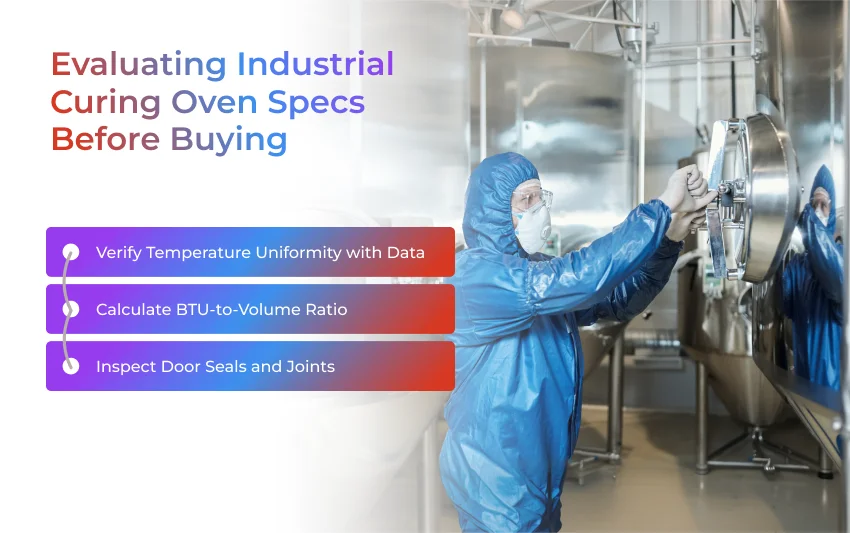
Step 1: Verify Temperature Uniformity with Test Data
Request documented temperature uniformity test data, not specification claims. Ask whether testing was conducted under loaded or unloaded conditions. Loaded testing with representative parts provides more relevant data than empty chamber tests, which are easier to optimize for and less representative of real production conditions.
If buying a used paint curing oven, perform your own uniformity test before accepting delivery, or at minimum, negotiate a post-delivery test with a return option if the unit fails your specification threshold of plus or minus 5 degrees Fahrenheit across the chamber.
Step 2: Calculate BTU-to-Volume Ratio Against Your Load Mass
Calculate the BTU-to-volume ratio for any oven you're evaluating: divide total BTU/hr output by interior cubic feet. Industrial production ovens should deliver a minimum of 300 to 400 BTU/hr per cubic foot of interior volume for adequate recovery performance under production loading conditions. Cure verification testing methodology is outlined in ASTM D3451, the standard guide for testing coating powders and powder coatings, which emphasizes measuring time at actual part temperature rather than oven air temperature.
Step 3: Inspect Construction at Door Seals and Panel Joints
Physical inspection of door gasket condition, panel joint sealing, and heating element access reveals build quality that specifications cannot capture. Look for gaps at panel joints, compressed or deteriorated door gaskets, and any signs of heat discoloration outside the door perimeter that indicate seal failure under operating conditions.
Conclusion
Oven size and temperature uniformity are the two specifications that most directly determine whether your powder coating operation produces consistent, saleable finishes at production volume. Creative Coating Solutions Understanding BTU output, dwell time, and construction quality separates shops that run smooth production from those constantly chasing quality problems.
Contact or call Scott directly at (618) 741-0740 to discuss your shop's specific requirements and get a recommendation matched to your part sizes, load mass, and daily production targets.
FAQ
What temperature uniformity should a batch oven achieve?
A production batch oven should achieve ±5°F uniformity across nine test positions. Budget ovens show 15 to 25 degree variance, consuming 30 to 50% of the cure window and causing quality variation.
How to calculate the right size for a batch oven?
Calculate oven size by starting with your largest typical part's envelope dimensions and adding a minimum of 6 to 8 inches in each direction for hang spacing and airflow clearance. This gives you the minimum interior dimensions. Next, verify that door opening dimensions allow your largest parts to actually enter the chamber, as door opening is frequently smaller than the interior volume. Check that the oven's BTU output can heat your maximum expected load mass from ambient temperature to cure temperature within your acceptable cycle time. Use the formula: load mass times specific heat times required temperature rise equals minimum BTU input required before dwell time begins.
Oven air temp vs peak metal temp in powder curing?
Oven air temperature is what the thermostat controls and what temperature gauges display. Peak metal temperature (PMT) is the actual temperature the coated metal surface reaches during the cure cycle. PMT typically lags oven air temperature by 5 to 20 minutes, depending on substrate mass, thermal conductivity, and load density. Powder cure specifications on manufacturer data sheets always refer to PMT, not oven air temperature. A shop setting oven temperature to 375 degrees Fahrenheit and timing cure from when the oven gauge reads 375 is systematically undercuring all parts thicker than about 18 gauge steel, because those parts' surfaces haven't yet reached 375 at that moment.
Electric vs gas powder coating oven for your shop?
Electric ovens offer precise control and no combustion byproducts. Gas delivers higher BTU at lower fuel cost, making it standard for large production ovens.
How often should a powder coating batch oven be serviced?
Production batch ovens need quarterly door gasket checks, annual fan and element cleaning, and bi-annual calibration. Preventive maintenance costs a fraction of unplanned failure downtime.