The right industrial spray booth depends on your part size, coating type, daily production volume, and local compliance requirements. Powder coating shops need a booth rated for 60 linear feet per minute airflow, while liquid paint requires 100 fpm to meet OSHA and NFPA 33 standards. Size your booth to your largest regular part with clearance on all sides, and match the exhaust fan CFM to the booth's internal volume before you order anything.
Key Takeaways
- Powder coating booths require a minimum airflow of 60 linear feet per minute under NFPA 33 standards, while wet paint booths need 100 fpm to stay compliant.
- Booth size should be based on your largest regular part with at least 12-18 inches of clearance on each side for proper airflow and operator movement.
- Downdraft, crossdraft, and side-downdraft booths each suit different production environments, and choosing the wrong airflow direction affects both finish quality and compliance.
- Filter changes for high-production shops running 4 or more hours per day should happen every 1-2 months on exhaust filters to maintain airflow and coating quality.
- Creative Coating Solutions supplies powder spray booths for shops across the USA, along with filtration, fans, and complete booth accessories.
Most shops buy their spray booth the same way they buy a pickup truck. They look at the size that seems about right, check the price, and order it.
Six months later they're calling us.
The booth is too small for their larger parts. Or the airflow doesn't meet the local fire marshal's requirements. Or they bought a paint booth and they're doing powder coating, and now their overspray recovery is a mess.
An industrial spray booth isn't just a box with a fan. It's a compliance system, a production tool, and a worker safety system all at once. Buy the wrong one and you're either running it out of compliance, fighting it on every large job, or rebuilding your whole setup within two years.
Shops across the USA setting up or upgrading their powder coating or liquid paint operations ask us these same questions constantly. This guide covers exactly what to match before you buy: booth type, size, airflow requirements, filtration, and what the compliance specs actually mean for your operation.
What is an industrial spray booth?
An industrial spray booth is an enclosed or semi-enclosed workspace designed to contain overspray, control airflow, and protect workers during coating application. It uses intake and exhaust fans to maintain a consistent air velocity across the work area, which carries overspray particles away from the operator and into filtration before air is exhausted outside. Spray booths are required by OSHA and NFPA 33 for most commercial and industrial coating operations.
Powder Coating Booth vs Paint Spray Booth: They're Not the Same
This is the first thing to get right. A powder coating booth and a liquid paint spray booth look similar from the outside. Inside, they work completely differently, and using the wrong one for your process causes problems you can't easily fix.
Powder coating booths are designed to capture dry powder overspray. They run at lower airflow velocities, typically 60 linear feet per minute, because powder particles are heavier than liquid paint mist and don't need as aggressive an air current to be captured. Many powder booths include a powder recovery system that collects overspray for reuse, which reduces material waste significantly.
The electrostatically charged powder in a powder coating operation also behaves differently in airflow than liquid paint does. Too much airflow in a powder booth disrupts the electrostatic charge and pulls powder away from parts before it bonds, which hurts transfer efficiency and wastes material.
Liquid paint spray booths operate at higher airflow velocities, typically 100 linear feet per minute, because solvent vapors need to be moved out of the booth quickly to stay below the explosive limit threshold required by NFPA 33 and OSHA 29 CFR 1910.107. Running a liquid paint booth at powder coating airflow speeds puts workers at risk and puts you out of compliance.
So before anything else: know which process you're running. Creative Coating Solutions' powder spray booth lineup is designed specifically for powder coating operations, with airflow and filtration matched to powder overspray capture requirements.
What is the difference between a powder coating booth and a paint spray booth?
A powder coating booth runs at 60 linear feet per minute airflow to capture dry powder overspray without disrupting electrostatic application. A paint spray booth runs at 100 fpm or higher to keep solvent vapors below the explosive limit. Using a paint booth for powder coating wastes material by disrupting charge transfer. Using a powder booth for liquid paint creates a compliance and safety problem. The two systems are not interchangeable.
Not sure whether you need a powder spray booth or a liquid paint spray booth for your setup?
Our team at Creative Coating Solutions helps shops across the USA spec the right system for their coating process and production volume.
|
Booth Airflow Types: Crossdraft, Downdraft, and Side-Downdraft
Once you know whether you need a powder or paint booth, the next choice is airflow direction. This affects finish quality, filter placement, overspray capture, and how easy the booth is to use day to day.
Crossdraft booths pull air horizontally from one end of the booth to the other. Intake filters are at the front, exhaust filters are at the back. This is the most common and cost-effective configuration for small to mid-size shops.
The limitation with crossdraft is that overspray travels across the part before being exhausted. On larger parts, this can mean the upstream side of the part gets more overspray contamination from the working area. For high-quality finishes on complex or large parts, crossdraft is less ideal.
Downdraft booths pull air downward from the ceiling, through the floor grating, and out through exhaust filters below. This is the cleanest airflow direction for surface quality because overspray moves away from the part surface as soon as it misses. Downdraft booths produce better finish consistency on complex geometry.
The tradeoff is cost and facility requirements. Downdraft booths need a pit below the floor or a raised platform for the exhaust system. Installation is more involved and the upfront investment is higher.
Side-downdraft booths bring intake air in through the ceiling and exhaust through the lower side walls. This is a practical middle ground when you want cleaner airflow than a crossdraft offers but don't have the facility infrastructure for a full downdraft.
For most powder coating shops across the USA running batch work on varied part sizes, a crossdraft or side-downdraft configuration covers the majority of production needs at a more accessible price point.
Read More About: 5 Critical Factors to Evaluate Before Buying a Powder Coating Spray Booth
Airflow Type
|
Best For
|
Finish Quality
|
Installation Cost
|
Crossdraft
|
Small to mid-size shops, varied parts
|
Good
|
Lowest
|
Side-downdraft
|
Mixed production, medium complexity
|
Better
|
Moderate
|
Downdraft
|
High-quality production, complex parts
|
Best
|
Highest
|
What type of spray booth airflow is best for powder coating?
Crossdraft and side-downdraft booths work well for most powder coating operations. Downdraft booths offer the cleanest overspray capture and best finish quality on complex geometry but require more facility infrastructure. For most shops running batch powder coating work, a crossdraft booth with proper airflow velocity and filter maintenance gives good, consistent results without the higher installation cost of a downdraft system.
How to Size an Industrial Spray Booth for Your Parts
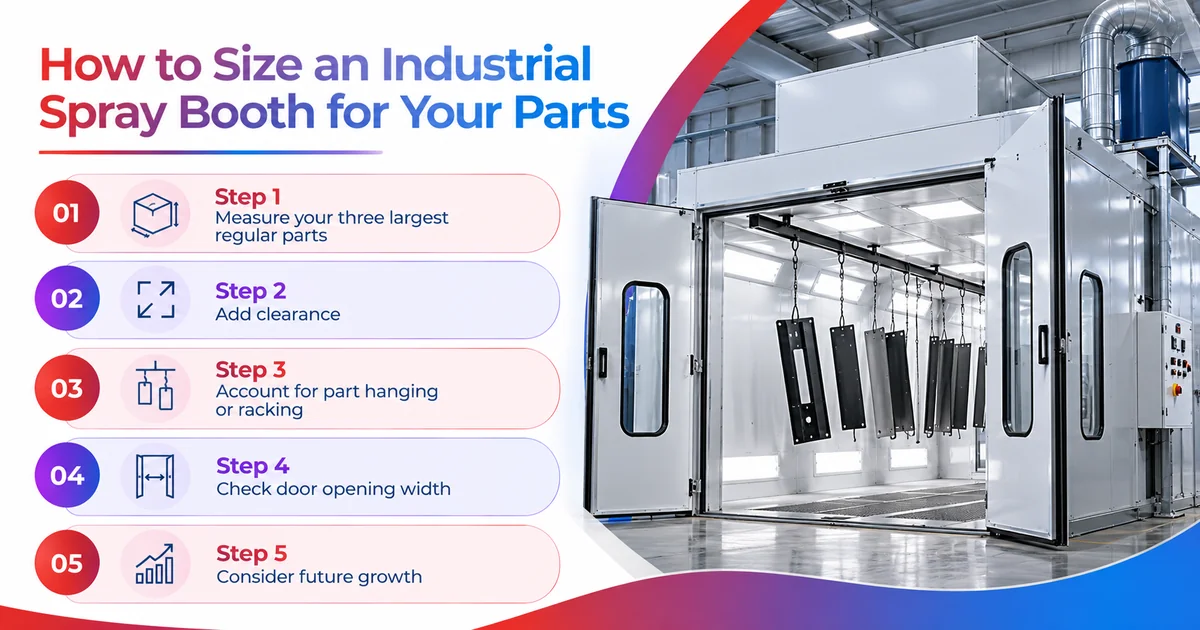
Booth sizing is where most shops underestimate what they actually need.
The rule is simple but people skip it. Your booth interior needs to be large enough that your largest regular part fits inside with at least 12-18 inches of clearance on all sides. That clearance isn't a comfort room. It's a functional airflow space. When parts fill too much of the booth cross-section, airflow can't move uniformly around the part, and overspray capture gets inconsistent.
Here's how to work it out before you order:
Step 1 - Measure your three largest regular parts
Length, width, and height for each. The biggest dimensions in each direction set your minimum booth interior size.
Step 2 - Add clearance
Add 18 inches minimum on each side and 24 inches above the part for ceiling clearance. This gives airflow room to work and gives your operator room to move the gun around the part.
Step 3 - Account for part hanging or racking
Parts hang from an overhead conveyor or manual hooks in most booths. Add the hook or rack height to your total height requirement so you're not hanging parts that touch the booth floor.
Step 4 - Check door opening width
The booth door needs to be wide enough to bring your largest parts in and out. This sounds obvious, but it's a common oversight that requires modification after delivery.
Step 5 - Consider future growth
If your shop is growing, size slightly ahead of current needs. Replacing a booth because you outgrew it in 18 months costs more than upsizing once.
Creative Coating Solutions carries industrial spray booths for powder coating in multiple configurations to fit shops of different sizes across the USA.
Also Worth Knowing: Your spray booth throughput needs to match your curing oven capacity. If your booth processes parts faster than your oven cures them, you'll create a production backlog. See how Creative Coating Solutions matches curing ovens for powder coating to booth output. View oven options
Airflow and CFM Requirements: What the Compliance Numbers Mean
This section matters more than most buying guides admit. Airflow compliance isn't just about getting a permit. It directly affects your finish quality, your workers' safety, and your ability to pass a fire marshal inspection.
Here are the numbers that govern spray booth airflow in the USA:
- Powder coating booths: Minimum 60 linear feet per minute (lfm) airflow velocity across the booth cross-section (NFPA 33 and Tools USA industry reference)
- Liquid paint and solvent-based coating booths: Minimum 100 lfm, or sufficient airflow to maintain solvent vapor concentration below 25% of the lower explosive limit (OSHA 29 CFR 1910.94, NFPA 33)
The booth's CFM requirement depends on the cross-sectional area of the booth in the direction of airflow. For a crossdraft booth that's 10 feet wide and 8 feet tall:
- For powder coating: 10 x 8 x 60 fpm = 4,800 CFM minimum exhaust fan capacity
- For liquid paint: 10 x 8 x 100 fpm = 8,000 CFM minimum
Your exhaust fan must actually deliver this CFM at static pressure, not just in free air. Fan curves from the manufacturer show rated CFM at different static pressures. Check the fan curve at the estimated static pressure of your filter system before assuming the fan meets your requirements.
Your local Authority Having Jurisdiction (AHJ), typically the fire marshal or building inspector, has final say on compliance in your area. Requirements can vary by location, and some jurisdictions have additional requirements beyond NFPA 33 minimums. Confirm with your local AHJ before finalizing booth specifications.
How much airflow does a powder coating spray booth need?
A powder coating spray booth needs a minimum airflow velocity of 60 linear feet per minute across its cross-section, per NFPA 33 and industry standards. The exact CFM requirement depends on booth width and height. A 10-foot wide, 8-foot tall booth needs at least 4,800 CFM from the exhaust fan at working static pressure. Always verify with your local Authority Having Jurisdiction since requirements can vary by location.
Filtration: What You Actually Need to Keep Running
Filters are the maintenance item most shops underestimate until a filter problem shuts down a production run.
Industrial spray booths use two main filter stages:
Intake (supply) filters clean the air coming into the booth before it reaches the work area. Contaminated incoming air introduces dust and particulates into your finish. Intake filters should be inspected monthly and replaced when visibly loaded or when booth pressure differential increases noticeably.
Exhaust filters capture overspray before air leaves the booth. In powder coating booths, exhaust filters capture the dry powder particles that don't land on parts. These load faster than intake filters in high-production environments.
For shops running 4 or more hours of spraying per day, industry guidelines suggest exhaust filter changes every 1-2 months. Intake filter changes every 2-3 months. Actual intervals depend on your production volume and material type. A loaded exhaust filter restricts airflow, drops your booth velocity below compliance minimums, and causes overspray to back up toward the operator.
Signs your filters need attention:
- Booth airflow feels noticeably weaker than normal
- Overspray is drifting toward you instead of being captured
- Finish quality is declining without changes to your gun settings
- Your pressure differential gauge shows higher than normal static pressure
Creative Coating Solutions stocks spray booth filters for powder coating booths, including intake and exhaust filter replacements that ship fast across the USA.
How often should I change spray booth filters in a powder coating shop?
For shops running powder coating 4 or more hours per day, change exhaust filters every 1-2 months and intake filters every 2-3 months. Lower-volume operations can extend these intervals, but always monitor airflow velocity and pressure differential as indicators. A loaded filter reduces airflow below compliance minimums, which creates both a quality problem and a safety issue. Replace filters on a schedule, not just when you notice a problem.
Not sure what booth size, airflow spec, or filter setup your shop needs?
Our team puts together complete spray booth recommendations for shops across the USA based on your specific coating process and production volume.
|
What to Look for Before You Buy
Before you finalize any industrial spray booth purchase, run through this checklist:
Coating process match
Is the booth rated for powder coating, liquid paint, or both? Confirm the airflow velocity and filtration system match your process.
Interior dimensions vs your largest part
Measure your parts first. Confirm the booth interior gives you 12-18 inches clearance on each side and 24 inches above the hung part.
Fan and motor compliance
Exhaust fan motors in spray booths must be explosion-proof or located outside the booth in most configurations under NFPA 33. Verify the booth's motor placement and rating before purchase.
Filter access and serviceability
Can you change filters without special tools or partially disassembling the booth? Filter access that's awkward in practice means filters get changed less frequently.
Makeup air system compatibility
In many climates, exhausting booth air in winter means you're also exhausting heated shop air. A makeup air unit replaces exhausted air with conditioned outside air. Confirm whether your facility needs one and whether the booth is designed to integrate with it.
Local AHJ pre-approval
Before ordering, confirm the booth specifications with your local fire marshal or building inspector. Getting this wrong after the booth is installed is expensive to correct.
Supplier parts availability
Fans, motors, and filters are wear items. Confirm replacement parts are available from the supplier before you're dependent on a booth model that's out of production or hard to source.
Conclusion
Buying the right industrial spray booth comes down to matching the booth to your process, your parts, and your compliance requirements, in that order.
A powder coating booth and a liquid paint booth have different airflow requirements, different filtration systems, and different compliance standards. Getting that wrong first creates problems everything downstream can't fix. Size the booth to your largest parts with proper clearance, confirm your exhaust fan delivers the required CFM at working static pressure, and verify your specifications with your local AHJ before ordering.
Shops across the USA that go through this process before they buy save themselves booth replacements, compliance violations, and production bottlenecks that compound over months of operation.
Creative Coating Solutions supplies powder spray booths for operations of every size, along with filters, fans, curing ovens, and complete coating shop equipment. Everything ships fast from Fenton, Missouri.
Call (618) 741-0740 or email scott@creativecoatingsolutions.com to talk through your booth requirements. Get the spec right before you order and the rest of your shop setup falls into place a lot easier.
FAQs
What size industrial spray booth do I need for powder coating?
Size your booth so your largest regular part fits inside with at least 12-18 inches of clearance on all sides and 24 inches of headroom above the hanging part. For most automotive wheel and bracket work, a 4x4x6-foot booth handles the majority of jobs. For larger structural components, panels, or frames, you'll need a larger enclosure. Measure your three largest recurring parts before shopping and use those dimensions as your minimum interior size.
What is the minimum airflow for a powder coating booth in the USA?
Powder coating booths require a minimum airflow velocity of 60 linear feet per minute across the booth cross-section under NFPA 33 and OSHA guidelines. Liquid paint booths need 100 fpm minimum. The exact CFM your exhaust fan must deliver depends on your booth's width and height in the direction of airflow. Your local Authority Having Jurisdiction may have additional requirements beyond these federal minimums, so always confirm locally before finalizing specifications.
Does Creative Coating Solutions sell industrial spray booths across the USA?
Yes. Creative Coating Solutions supplies powder spray booths, booth filters, exhaust fans, and booth accessories for shops across the USA. They're a veteran-owned business based in Fenton, Missouri, with fast shipping on in-stock items. Call (618) 741-0740 or email scott@creativecoatingsolutions.com to discuss your booth requirements and get a quote.
What's the difference between a crossdraft and a downdraft spray booth?
A crossdraft booth pulls air horizontally across the booth from intake to exhaust, which is lower-cost and simpler to install. A downdraft booth pulls air from the ceiling down through floor grating, which produces cleaner airflow around parts and better finish quality on complex geometry. Downdraft booths require a pit or raised floor for the exhaust system, which adds to installation cost and facility requirements. For most powder coating shops, a crossdraft or side-downdraft booth covers daily production needs effectively.
Do I need a makeup air unit for my spray booth?
In most commercial and industrial installations, yes. Your spray booth exhaust fan moves large volumes of air out of the building, which creates negative pressure inside the shop. Without a makeup air unit replacing that exhausted air, shop air rushes in through gaps in the building, bringing dust and contaminants with it. In colder climates, exhausting booth air in winter also means exhausting heated shop air, which raises energy costs significantly. A makeup air unit conditions incoming air and maintains proper booth pressure balance.
How long does a powder coating spray booth last?
A well-built industrial spray booth from a reputable manufacturer typically lasts 10-15 years with regular filter maintenance and basic upkeep. Fan motors, belts, filters, and seals are the primary wear items. Shops running 4 or more hours per day should plan for more frequent filter changes and an annual inspection of fan bearings and seals. The booth structure itself lasts much longer than the mechanical components when properly maintained.
Why is my spray booth not capturing overspray properly?
Poor overspray capture in a powder coating booth typically traces back to loaded exhaust filters reducing airflow below the 60 fpm minimum, a fan that's undersized for the booth volume, booth leaks allowing uncaptured air paths, or parts that are too large for the booth interior and blocking uniform airflow. Check your filters first. Then verify actual airflow velocity with an anemometer. If the booth has never met capture performance from day one, the fan CFM or booth size may have been incorrectly specified from the start.
What electrical requirements does a spray booth need?
Spray booth exhaust fan motors typically run on 208-240V or 480V three-phase power depending on motor size. Booth lighting must use explosion-proof fixtures in the spray area under NFPA 33 and OSHA 1910.94 requirements. All electrical wiring inside the spray zone must be rated for the environment and conform to your local electrical code. Confirm your facility's available power supply matches the booth's electrical requirements before ordering, and have your electrical contractor review the installation specs.