Nobody warns you about this when you're getting into powder coating. You spend all this time researching ovens, comparing booths, picking out the perfect spray system—and then reality hits. The equipment is only part of the equation. What actually separates shops that run smoothly from ones constantly putting out fires? Having the right maintenance tools ready before something breaks.
I can't tell you how many times I've heard about coating operations losing an entire day of production over a $20 part they didn't have on the shelf. That's money walking out the door. And it's completely avoidable.
So let's get into what your commercial powder coating equipment actually needs to stay healthy—and the supplies that should already be sitting in your maintenance area.
Preventive Maintenance Isn't Optional Anymore
Think about what you've got invested in your industrial powder coating equipment. Ovens run five figures. Booths that cost real money. Spray systems, compressors, and pretreatment setups. None of this stuff is cheap, and all of it needs attention.
Here's what people miss, though: maintained equipment doesn't just last longer. It actually performs better. Your finishes come out more consistent. Your production schedule stays intact. You're not scrambling to reschedule jobs because something decided to quit on a Tuesday morning.
Shops that treat maintenance like an afterthought always pay for it eventually. Usually, right when they've got their biggest customer's order due.
The smarter play? Build your maintenance routine around having the right tools and supplies on hand. Catch the small stuff before it turns into expensive emergencies. Keep your powder coating machines humming along like they're supposed to.
Taking Care of Your Spray Guns
Your application equipment works harder than anything else in the shop. Day after day, shift after shift. Powder builds up in places you don't want it. Worn items slowly deteriorate. Ignore the warning signs and small annoyances become real problems.
Here's what every shop needs for spray gun maintenance:
- Extra electrode tips and nozzles in the sizes you actually use
- Cleaning brushes made specifically for powder gun internals
- Compressed air blow-off attachments that reach the tight spots
- Spare powder hoses and fittings—these fail more often than you'd think
- Grounding cables and clips in good condition
- O-ring kits matched to your specific gun models
Get in the habit of cleaning your guns when you're done for the day. Five minutes of attention prevents the kind of caked-on buildup that throws off your spray patterns and kills your transfer efficiency. Once a week, actually inspect your wear items. Swap out anything that's looking rough before it starts affecting your finish quality.
Running tribo guns? Pay extra attention to your charging components. Corona systems need regular electrode checks. Know your equipment inside and out, and stock parts for what you're actually using.
Stay Ahead with Proper Powder Coating Maintenance
Stock up on essential tools to avoid costly downtime and keep your equipment running smoothly.
|
Booth Cleaning Supplies You'll Actually Need
Your powder coating booth basically acts as a collection point for everything that doesn't stick to parts. All day long, overspray accumulates. Skip the cleaning and you'll end up with airflow problems, contamination during color changes, and eventually safety headaches you don't want to deal with.
Keep these booth maintenance items stocked:
- A decent HEPA-rated vacuum or attachments that can handle powder
- Non-sparking scrapers and brushes—this matters more than people realize
- Replacement filters for both pre-filtration and final stages
- Spare light covers and bulbs because visibility matters
- Seal strips and weather stripping for booth doors
- Cleaning solutions that won't create static problems
How often you clean depends on how much you're running. Busy shops pumping out parts all day might need to hit the booth daily. Lower-volume operations can sometimes get away with weekly deep cleaning. Either way, don't let the buildup get ahead of you.
And filters? Pay attention to them. Clogged filters choke your airflow, reduce how well the booth captures overspray, and make your exhaust system work harder than it should. If your booth has pressure drop indicators, actually look at them. Otherwise, stick to a replacement schedule and do visual checks regularly.
What Your Oven Maintenance Kit Needs
Curing ovens run hot and they work constantly. Temperature consistency is everything when it comes to finish quality, so keeping your oven dialed in isn't something you can skip. It directly affects whether your coated parts come out right.
Build your oven maintenance toolkit around these items:
- Temperature verification equipment that's actually calibrated
- Replacement heating elements for your specific oven
- High-temp sealant and gasket material
- Thermocouple testers plus spare sensors
- Oven cleaning solutions rated for the temperatures you're running
- Combustion analyzer if you're using gas-fired equipment
Door seals deserve more attention than they usually get. Heat leaking around worn-out gaskets wastes energy and creates hot and cold spots inside your cure chamber. Replace seals before they completely fail and start costing you money.
Do temperature uniformity surveys at least quarterly if you're running steady production. Write down your readings and watch for any drift over time. Catching calibration issues early means you're not wondering why an entire batch came out under-cured.
Check Out Our Products: Explore High-Quality Air Tools for Powder Coating
Air System Maintenance Matters More Than You Think
Clean, dry air makes everything work better. Moisture sneaking into your system causes adhesion failures and fisheyes. Oil contamination creates defects that send parts back for rework. Your air quality affects every single thing you coat.
Stock these air system maintenance supplies:
- Replacement filter elements for every stage of filtration
- Desiccant refills or replacement cartridges for your dryers
- Pressure gauges and regulators
- Drain valves and automatic condensate drains
- Air line lubricants where appropriate
- Leak detection solution
Make draining moisture from your compressor tank and drip legs part of your daily routine. Replace inline filters when the manufacturer says to—or sooner if you're in a humid climate or running high volume.
Test your air quality now and then. A simple water trap test tells you whether your drying setup is actually doing its job. Contaminated air wastes powder and ruins finishes. This stuff matters even if it's not the exciting part of running a coating shop.
General Shop Tools You Can't Skip
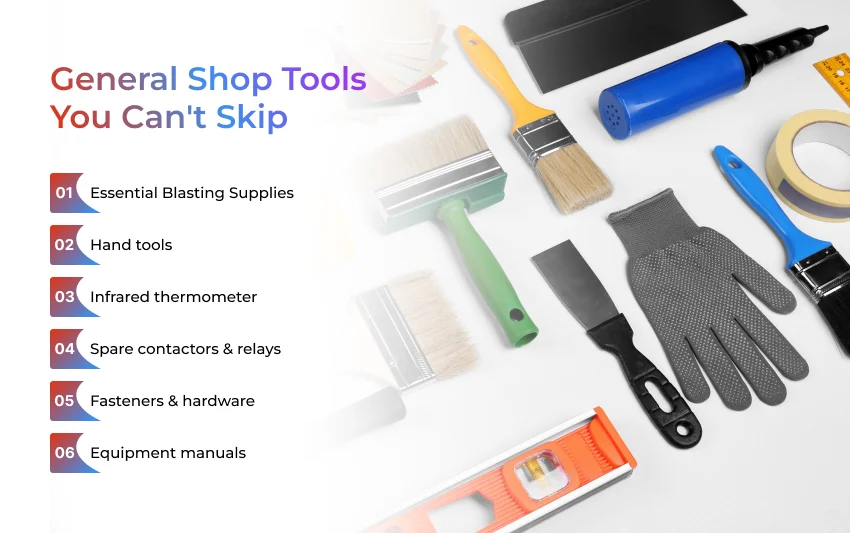
Beyond the equipment-specific stuff, every coating operation needs basic maintenance tools within reach when something goes sideways.
Make sure you've got:
- A multimeter for tracking down electrical issues
- Standard hand tools—wrenches, screwdrivers, pliers
- An infrared thermometer for quick temperature spot-checks
- Spare contactors and relays for your critical systems
- Assorted fasteners, bolts, and mounting hardware
- Equipment manuals and parts diagrams you can actually find
Organize this stuff so anyone on your team can grab what they need without hunting around. Labeled bins, shadow boards, dedicated cabinets—whatever works for your space. Wasted time searching during equipment problems is just wasted money.
Creating a Maintenance Schedule That Works
Having tools on hand is step one. Actually using them consistently is what makes the difference. Build yourself a maintenance calendar:
- Daily: Gun cleaning, drain your air system, quick visual inspection of everything
- Weekly: Booth cleaning, check your filters, look over wear items
- Monthly: Check electrical connections, inspect oven seals, do a thorough cleaning
- Quarterly: Verify temperature calibration, comprehensive review of all systems
Write things down. Maintenance logs help you see patterns, anticipate when parts are likely to fail, and make the case for equipment upgrades when the time comes.
Keep Your Powder Coating Shop Running Smoothly
Stock the essential maintenance tools to avoid costly downtime and improve equipment performance.
|
Finding a Supplier Who Gets It
Working with a powder coating equipment supplier who carries maintenance items alongside the big equipment makes your life significantly easier. One source for replacement parts, consumables, and the tools that keep everything running—instead of juggling a dozen different vendors and tracking multiple orders.
Look for distributors who understand what daily production actually demands. The ones who keep inventory on hand so you're not waiting around when you need something fast.
Creative Coating Solutions is a U.S. veteran-owned supplier built around the real needs of powder coating, sandblasting, and metal finishing operations across America. We stock professional-grade powder coating tools, maintenance supplies, replacement parts, and industrial accessories that hold up in demanding production environments. Our team knows what it takes to keep shops running—because we've spent years working alongside owners and operators solving exactly these problems.
Running low on maintenance supplies or need parts to keep your equipment performing? Check out our full inventory and get what you need shipped quickly so you can minimize downtime and keep production moving.
FAQs
How often should I clean my powder coating spray guns?
+
Powder coating spray guns should receive a thorough cleaning after every 40 hours of operation, or at the end of each production day in high-volume environments. Perform a full teardown — cleaning all internal passages, replacing worn tips, and inspecting electrode condition — at least monthly. Consistent cleaning maintains transfer efficiency and prevents powder buildup that causes application inconsistencies and electrostatic performance loss.
What causes most powder coating equipment breakdowns?
+
The majority of powder coating equipment failures are preventable and trace back to three root causes: neglected air system maintenance allowing moisture or oil contamination, failure to replace oven door seals leading to heat loss and temperature inconsistency, and worn spray gun components reducing electrostatic charging efficiency. Shops that follow manufacturer-recommended service intervals and stock common wear parts experience significantly less unplanned downtime.
Which booth filters need replacing most often?
+
Primary intake filters in open-face booths typically require replacement every 30–60 days in active shops. Cartridge filters in enclosed booths last longer — often 6 to 12 months — but must be replaced or pulse-cleaned when differential pressure across the filter bank exceeds 1.5 inches of water column. Pre-filters protecting the primary media should be inspected and changed monthly to extend cartridge life and maintain proper booth airflow velocity.
How can I tell when my oven needs calibration?
+
Signs your powder coating oven needs calibration include inconsistent gloss levels across parts in the same load, under-cure failures (powder that scratches off easily after curing), and visible color variation on same-batch parts. Use a calibrated multi-point data logger with at least nine thermocouples to run a temperature uniformity survey quarterly. A variation of more than ±15°F across the work zone indicates recalibration, element inspection, or recirculation fan service is needed.
Should I keep spare parts for all my equipment?
+
Yes. Stock spare parts for every piece of equipment that would halt production if it failed. At minimum, maintain gun rebuild kits, oven door gaskets, booth filter cartridges, compressor belts, and dryer filter elements on-site at all times. For critical components with long lead times — such as control boards or recirculation fan motors — carry one spare unit. The cost of stocking parts is always less than one full day of lost production.
What maintenance supplies should every powder coating shop have on hand?
+
Every powder coating shop should stock gun cleaner fluid and rebuild kits, booth filter media, polyethylene liner rolls, oven door gaskets, multi-point thermocouple data logger, refrigerated dryer filter elements, coalescing filter cartridges, electronic leak detector, HEPA shop vacuum, and a calibrated pressure gauge. Organizing these items in a dedicated maintenance area with a replenishment checklist prevents stockouts during peak production periods.
How do I create a powder coating equipment maintenance schedule?
+
Build your maintenance schedule around three tiers: daily tasks (drain air dryer separators, visually inspect gun tips and booth filters, log oven temperature), weekly tasks (clean gun internals, check booth airflow velocity, inspect oven door seals), and quarterly tasks (full temperature uniformity survey, gun rebuild, air system leak check, oven element and fan belt inspection). Tie each task to a specific person and log completion in a maintenance binder or digital system reviewed monthly.