The right media blaster for a powder coating shop depends on your part size, daily production volume, and available air supply. Portable pressure blasters suit small to mid-size shops handling varied parts. Larger siphon or pressure units with higher CFM ratings work better for consistent high-volume runs. Match your blaster to your compressor, your media type, and the parts you coat most often.
Key Takeaways
- Pressure blasters deliver more aggressive cleaning than siphon blasters and suit most powder coating prep work on steel and aluminum.
- Your air compressor's CFM output determines which media blaster you can actually run without starving the nozzle mid-job.
- Aluminum oxide at 80-100 grit is the most widely used media for powder coating prep on steel, producing the anchor profile powder needs to bond.
- A blaster that's too small for your parts forces multiple passes, wastes media, and slows down your whole coating workflow.
- Portable abrasive blasters from 5-gallon to 250-pound capacity handle most shop needs without requiring a permanent blast room installation.
Here's a mistake that costs shops time on every single batch.
You spend money on quality powder and a good oven, you nail your gun settings, and the finish still fails early. Chips off. Peels at the edges. Doesn't look right after 6 months in service.
Nine times out of ten, the problem started before the gun ever came out. Inadequate surface prep, from the wrong media blaster or the wrong media type, is one of the leading causes of powder coating adhesion failures. You can't compensate for poor prep with better application technique.
Shops across the USA running powder coating operations, from small fab shops to production lines, face the same challenge when setting up blast prep: which media blaster actually fits the work they do?
This post breaks down exactly how to choose a media blaster for your shop. We'll cover blaster types, capacity matching, air supply requirements, media selection, and the questions to answer before you buy. By the end, you'll know what to look for and what to avoid.
What is a media blaster?
A media blaster is a tool that uses compressed air to propel abrasive particles at high velocity against a metal surface. The impact cleans rust, old coatings, mill scale, and contaminants, and creates a textured surface profile that gives powder coating something to bond to. Without proper blasting, powder coating adhesion is weaker and finishes fail faster, regardless of how well the powder is applied.
Pressure Blaster vs Siphon Blaster: Which Is Right for Powder Coating?
This is the first decision most shop owners get wrong. They buy a siphon blaster because it's cheaper, then spend twice as long prepping every part.
Here's the practical difference:
Siphon blasters use air pressure to create a vacuum that draws media up from a separate hopper. They're slower, less aggressive, and better suited for light cleaning or detail work where you need more control.
Pressure blasters force media out of a pressurized vessel directly through the blast hose. They're faster, more aggressive, and produce a cleaner, more consistent surface profile. For powder coating prep on steel, structural components, and anything with rust or mill scale, a pressure blaster gets the job done in significantly less time.
For most powder coating shops, a pressure blaster delivers faster prep and more consistent results. The cleaning speed alone justifies the price difference when you're running parts through regularly.
Which surface profile does your powder coating actually need? For most polyester powders on steel, a surface profile of 1-3 mils (25-75 microns) is appropriate. That profile requires an aggressive enough blast to produce angular peaks the powder can grip. Siphon blasters at low pressure often don't get there consistently.
What's the difference between a pressure blaster and a siphon blaster?
A pressure blaster uses a sealed pressurized vessel to push media through the blast hose, which produces faster cleaning and a more consistent surface profile. A siphon blaster draws media up through a tube using air vacuum, which is slower and less aggressive. For powder coating surface prep on ferrous metals, pressure blasters are the more practical choice because they produce the anchor profile powder coating needs to bond correctly.
How to Match Your Blaster to Your Air Compressor
Your air compressor is the limiting factor. Buy a blaster your compressor can't support and you'll starve the nozzle, slow down every job, and end up with inconsistent results.
Here's the core relationship to understand: blast nozzles require a specific CFM (cubic feet per minute) at working pressure to operate correctly. A typical 3/8-inch blast nozzle running at 100 psi requires roughly 50-75 CFM to maintain consistent media flow and velocity, per standard nozzle manufacturer specifications.
If your compressor puts out 30 CFM, a blaster with a 3/8-inch nozzle will starve it within minutes. You'll lose pressure, your blast pattern gets inconsistent, and parts don't get the profile they need.
Before buying a media blaster, confirm these numbers on your compressor:
- CFM output at your working pressure (usually 90-100 psi for steel)
- Tank size in gallons (larger tank means longer continuous blast time before the compressor cycles)
- Recovery time when the tank drops low
A general rule: your compressor should produce at least 1.5 times the CFM the blast nozzle requires to maintain consistent pressure during longer blasting sessions. For shops running industrial air compressors at 60-80 CFM and above, a 5-gallon to 40-pound portable pressure blaster will run without trouble on most part sizes.
What size air compressor do I need for a media blaster?
The size depends on your blast nozzle diameter. A 3/8-inch nozzle at 100 psi needs approximately 50-75 CFM. Most single-stage compressors in the 5-7.5 HP range produce 15-25 CFM, which is not enough for sustained pressure blasting on larger parts. For consistent powder coating prep work, a two-stage industrial compressor producing 40+ CFM gives you reliable performance without constant pressure drops between blasting passes.
Read More: Blast Media Types: How to Choose the Right One for Your Job
Choosing the Right Blast Media for Powder Coating
The blaster is only part of the equation. The media you run through it determines the surface profile depth, the cleanliness you achieve, and whether you'll damage softer metals like aluminum.
Here's a practical media selection guide for powder coating prep:
Metal Type
|
Recommended Media
|
Grit Range
|
Why
|
Steel (general)
|
Aluminum oxide
|
80-100 grit
|
Angular profile, reusable, aggressive enough for rust and mill scale
|
Steel (light cleaning)
|
Garnet
|
80-120 grit
|
Lower dust than aluminum oxide, good profile for powder
|
Aluminum
|
Crushed glass or glass bead
|
80-120 grit
|
Less aggressive, won't embed iron contamination in soft metal
|
Stainless steel
|
Glass bead
|
100-120 grit
|
Non-contaminating, produces clean matte profile
|
Delicate parts or thin gauge
|
Plastic media or walnut shell
|
Fine
|
Low pressure, won't distort thin material
|
Thick coatings or heavy rust
|
Steel grit
|
G40-G50
|
Maximum aggression for removing heavy scale
|
Aluminum oxide at 80-100 grit is the go-to for most steel powder coating prep across the USA. It's reusable through multiple cycles, cuts fast, and produces the angular profile that powder bonds to best.
One practical point: don't recycle media indefinitely without inspection. Broken-down media produces finer particles that create more dust and a shallower profile. Replace media when it starts to look powdery or when your blast time per part increases noticeably.
Once your blast prep is dialed in, your powder coating spray booth and curing oven need to match your throughput. See how Creative Coating Solutions supports complete shop setups: powder coating equipment and supplies
How to Size Your Media Blaster for Your Parts and Volume
The most common sizing mistake shops make: buying a blaster based on price instead of capacity for the work they actually do.
A 5-gallon pressure blaster holds enough media for cleaning a handful of small parts before you need to refill. That's fine for a hobbyist or a shop doing occasional small jobs. For a shop running 50-100 parts per day, you'll spend more time refilling the pot than blasting.
Here's a practical sizing guide:
Small parts and low volume (under 50 parts per day)
A 5-gallon to 10-gallon portable pressure blaster handles most small bracket, hardware, and wheel work without requiring permanent installation. These units are compact and can move around the shop as needed.
Mixed part sizes and moderate volume (50-150 parts per day)
A 40-pound to 100-pound pressure blaster gives you extended blast time without constant refills. Most shops in this range find the 40-pound unit covers 90% of their daily prep needs. Creative Coating Solutions carries portable abrasive blasters from 5 gallon right up to 250-pound capacity to fit production shops of every size.
Large structural parts or high-volume production
Parts exceeding 48 inches in any dimension or operations running 200+ parts daily typically need a blast room or a 100-pound-plus pressure blaster with media recovery. The larger the part, the more media you burn per cycle, and the faster a small pot becomes a production bottleneck.
Can I use a portable media blaster for powder coating prep on large parts?
Yes, for parts up to roughly 4-6 feet in length, a portable pressure blaster with a 40-100 pound capacity handles the work effectively. The limitation is that larger parts take more media per blast cycle, so you'll refill more often with smaller pots. For very large structural components like vehicle frames or industrial equipment, a dedicated blast room is more practical. For most shop work across the USA, a portable blaster in the 40-250 pound range covers the full range of part sizes.
Setting Up a New Blast System?
If you're setting up a new powder coating shop or upgrading your blast prep setup, our team puts together equipment recommendations based on your specific parts, volume, and air supply.
|
What to Look for in a Portable Abrasive Blaster
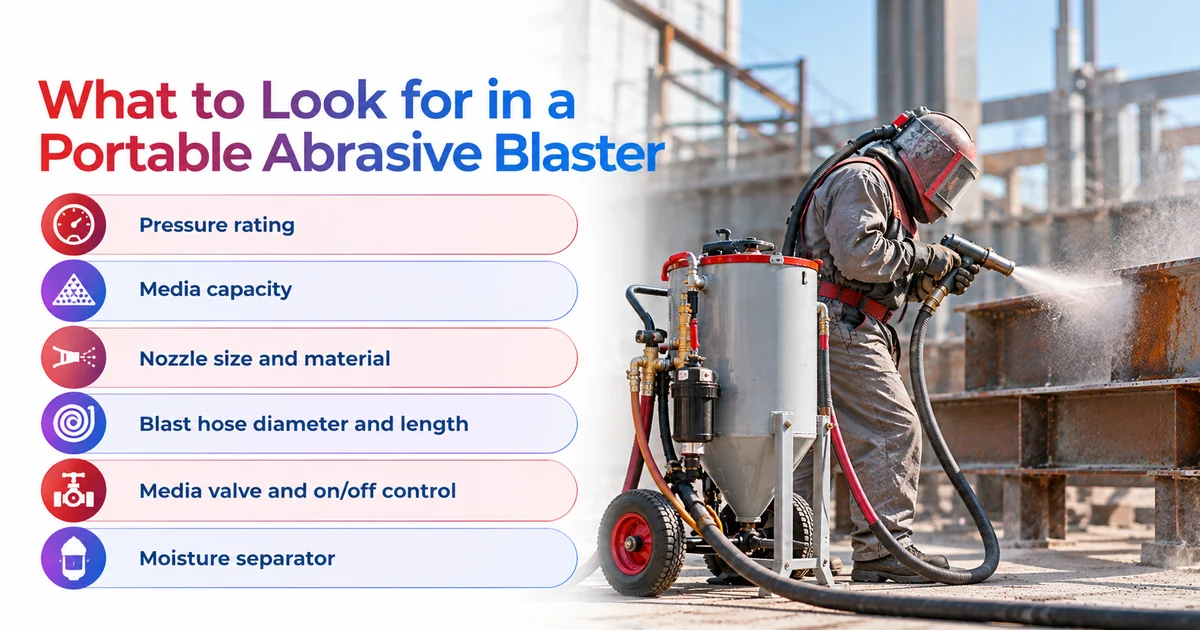
Not all portable blasters are built the same. Here's what actually matters when you're comparing models:
Pressure rating
Look for a unit rated to at least 125 psi. This gives you headroom to dial pressure down for softer metals and up for aggressive steel cleaning without operating at the equipment's limit.
Media capacity
Match the pot size to your daily volume as discussed above. Larger pots mean fewer refill stops but a heavier unit to move.
Nozzle size and material
Tungsten carbide or ceramic nozzles last significantly longer than cheaper steel nozzles under abrasive media. Replacing nozzles frequently adds up fast in a production shop.
Blast hose diameter and length
A longer hose gives you more flexibility around large parts, but adds pressure drop. A 1/2-inch ID hose at 25 feet is a good balance for most shop work.
Media valve and on/off control
A foot pedal or deadman handle gives you immediate shutoff when you need to reposition. Shops that skip this feature end up with wasted media and inconsistent blast patterns.
Moisture separator
Moisture in the blast stream contaminates the part surface before powder goes on, which causes adhesion failures. A quality inline moisture separator on the air line is not optional for powder coating prep work.
Does Creative Coating Solutions offer portable abrasive blasters in the USA?
Yes. Creative Coating Solutions stocks portable abrasive blasters from 5-gallon to 250-pound capacity for shops across the USA. They also carry blast media, protective blasting gear, and replacement parts. All orders ship fast from Fenton, Missouri. Call (618) 741-0740 or email scott@creativecoatingsolutions.com for availability and current specs.
Conclusion
Choosing the right media blaster for your powder coating shop isn't complicated once you know what to match.
Start with your air compressor's CFM output, then size your blaster to that. Pick a capacity that fits your daily part volume without constant refills slowing you down. Run aluminum oxide at 80-100 grit on steel for the surface profile powder coating needs, and switch to glass bead or crushed glass on aluminum to avoid contamination.
The surface prep stage is where your powder coating finish either succeeds or fails. A media blaster that's properly matched to your shop prevents adhesion failures, reduces recoat time, and gives your powder a clean, profiled surface to bond to on every batch.
Creative Coating Solutions stocks portable abrasive blasters from 5-gallon to 250-pound capacity, along with blast media, protective gear, and replacement parts, all shipping fast across the USA from Fenton, Missouri.
Call (618) 741-0740 or email scott@creativecoatingsolutions.com to get a recommendation based on your specific parts and production volume. Get the blast right and the rest of your process gets a lot easier.
Browse portable abrasive blasters
FAQs
What is the best media blaster for powder coating?
The best media blaster for powder coating is a pressure blaster sized to your daily production volume and matched to your air compressor's CFM output. For most shops, a 40-100 pound portable pressure blaster running aluminum oxide at 80-100 grit on steel handles the majority of prep work. The best unit is the one that matches your part sizes, your throughput, and your compressor without starving the nozzle mid-blast.
What blast media should I use for powder coating steel?
Aluminum oxide at 80-100 grit is the most widely used media for powder coating prep on steel. It produces an angular surface profile that gives powder coating a strong mechanical bond, it's reusable through multiple blast cycles, and it cleans rust and mill scale efficiently. For softer metals like aluminum, switch to crushed glass or glass bead to avoid iron contamination and surface damage from overly aggressive cutting.
How much air pressure do I need for media blasting before powder coating?
For most steel prep work before powder coating, nozzle pressure of 80-100 psi produces the right surface profile. Aluminum and other soft metals need reduced pressure of 40-60 psi to avoid excessive material removal. Your compressor needs to maintain working pressure consistently, not just peak at it. A compressor that drops below 70 psi during sustained blasting won't produce a consistent surface profile across the full part.
Does Creative Coating Solutions sell media blasters across the USA?
Yes. Creative Coating Solutions is a veteran-owned supplier based in Fenton, Missouri that stocks portable abrasive blasters from 5-gallon to 250-pound capacity, along with blast media, nozzles, and protective blasting gear. They ship to shops across the USA. Call (618) 741-0740 or email scott@creativecoatingsolutions.com for current product availability and specifications.
How often should I replace blast media in a powder coating shop?
Replace or inspect blast media when you notice it becoming visually powdery, when your blast time per part increases noticeably, or when your surface profile starts coming out shallower than expected. Aluminum oxide typically lasts 5-10 blast cycles before breakdown affects performance, depending on the hardness of parts you're blasting. Steel grit lasts longer. Glass bead breaks down faster on aggressive work. Regular media inspection prevents poor surface profiles from causing adhesion issues downstream.
Why does my powder coating peel even after blasting?
Peeling after blasting typically traces back to one of four issues: the surface profile was too shallow from worn-down media or low blast pressure; oil or moisture contamination was present on the part or in the air line; the part wasn't fully degreased before blasting; or the media type left iron contamination on aluminum, which prevents proper adhesion. Check your compressed air for moisture with a white cloth at the outlet, inspect your media condition, and degrease parts before and after blasting.
What's the difference between a media blaster and a sandblaster?
Sandblasting is an older term that originally described using silica sand as the abrasive. Media blasting is the broader term for using any abrasive material, including aluminum oxide, glass bead, garnet, steel grit, or plastic media. In modern powder coating shops across the USA, sandblasting typically refers to the same process as media blasting, but shops generally use aluminum oxide or garnet rather than silica sand, which produces harmful crystalline silica dust when inhaled.
How long does surface prep blasting take before powder coating?
Prep time depends on part size, existing coating condition, and the media blaster you're using. A small bracket with light surface rust typically takes 2-5 minutes in a pressure blaster at 90 psi. A larger automotive component with heavy scale might take 15-30 minutes. High-production shops running 100+ parts per day through a 40-pound pressure blaster find they can prep most standard parts in under 10 minutes per piece when the blaster is matched correctly to their air supply and part size.