Most shop owners start by picking out equipment first. They browse ovens, compare spray guns, and price out booths. Then the gear arrives, and they discover their electrical panel cannot handle the draw.
Maybe the compressor cannot keep up with daily demand. Maybe the oven will not fit through the bay door. These are expensive problems that happen every single week in coating shops across the country.
A pre-purchase facility audit prevents all of that entirely. Before you spend a single dollar on new equipment, you need to know exactly what your shop can support. This guide covers every key system.
Your electrical capacity, compressed air delivery, ventilation setup, and physical space all determine which gear your shop can actually run. Get these checked before you start comparing equipment specs.
Key Takeaways
- Check your electrical panel for available amperage and voltage before sizing any oven or booth
- Compressed air systems need a minimum of 15-20 CFM at 80-100 PSI for most powder coating guns
- Allow at least 3 feet of clearance around ovens and booths for safe operation and maintenance access
- Gas-fired ovens require dedicated gas lines rated for 200,000 to 400,000 BTU per hour, depending on size
- A facility audit before purchasing saves thousands in retrofit costs and prevents equipment downtime
Why a Pre-Purchase Facility Audit Saves Thousands Later
The Powder Coating Institute reports that roughly 30 percent of new shop setups require unplanned electrical upgrades after equipment arrives. Running this audit first eliminates those costly surprises.
Shop owners who skip the facility check face expensive change orders. An electrician charging $150 per hour to run new conduit and upgrade breakers adds up fast. Concrete work for gas lines costs even more.
You can avoid all of these problems with a tape measure, a multimeter, and about an hour of your time. The audit itself costs nothing, but it prevents thousands in unexpected retrofit work down the road.
"The number one mistake I see in new powder coating shops is underestimating electrical requirements. Owners buy the oven first and figure out the power second, and it always costs them more." Mark Richardson, Technical Director, Powder Coating Institute
Get these four systems right before you start shopping for industrial coating equipment, and every purchasing decision becomes easier.
Check Your Shop Before You Buy
A 30-minute facility walkthrough saves thousands in retrofit costs. Know your electrical, air, and space specs before ordering.
|
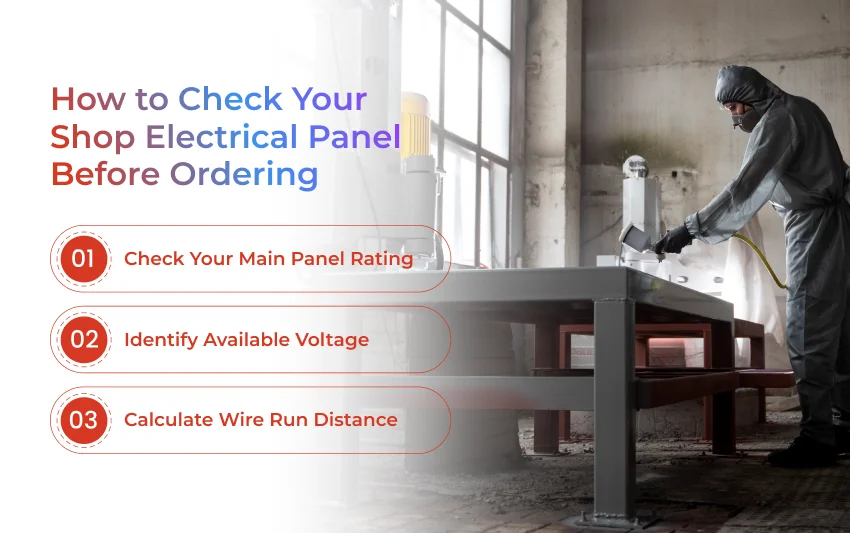
How to Check Your Shop Electrical Panel Before Ordering
Electrical capacity is the single biggest limiting factor in most shops. A standard batch powder coat oven draws between 30 and 60 amps on a 240V circuit. Larger production ovens on 480V pull even more.
If your panel lacks the available capacity for three-phase equipment pulling 80 to 150 amps, you will need a full panel upgrade before the oven ever gets plugged in. Always verify this requirement first.
Check Your Main Panel Rating
Start at the main breaker panel. Look at the total amperage rating stamped on the panel door. Most commercial shop panels are rated at 200 to 400 amps. Write down that number along with every installed breaker.
Add up the total amperage of every breaker currently installed in the panel and subtract from the main rating. The difference tells you exactly what capacity remains available for new powder coating equipment.
Identify Available Voltage
Powder coating ovens come in three common voltage configurations: 240V single-phase, 240V three-phase, and 480V three-phase. Single-phase 240V service is the most common voltage in smaller coating shops.
Three-phase power delivers significantly more capacity but is not available at every commercial location. Call your utility company to confirm what service type runs to your building before you order. Understanding your voltage options is critical when choosing the right powder coat oven for your shop.
Calculate Wire Run Distance
Long wire runs from the panel to equipment locations cause a voltage drop. The National Electrical Code recommends no more than 3 percent voltage drop on branch circuits. Measure every planned run distance.
For a 60-amp 240V circuit, that means a maximum wire run of about 115 feet using 6-gauge copper wire. Any longer runs require heavier gauge wire, which significantly adds to your total installation cost.
"I always tell shop owners to map their panel capacity and wire runs before they even look at equipment catalogs. A $200 electrical assessment upfront prevents a $5,000 surprise later."
Dave Martel, Master Electrician, National Electrical Contractors Association
Read More About Choosing the Right Powder Coat Oven for Your Shop
Compressed Air Volume and Clean Air Delivery for Coating
Every powder coating gun needs clean, dry compressed air to operate correctly. Most professional-grade corona guns require 8-12 CFM at 80-100 PSI, and fluidized bed hoppers add another 3-5 CFM on top.
Your shop compressor needs to deliver this volume consistently without cycling off and dropping pressure during application. Inconsistent air pressure kills finish quality and wastes expensive powder.
Minimum Compressor Sizing
Add up the CFM requirements for every air tool running simultaneously in your shop. A powder gun at 10 CFM, a blow-off nozzle at 5 CFM, and a blast cabinet at 20 CFM totals 35 CFM of continuous demand.
Your compressor should produce at least 1.5 times that total demand, so 52.5 CFM minimum for this example setup. Undersized compressors cause pressure drops, uneven powder delivery, and finish defects.
Air Quality Requirements
Powder coating demands moisture-free, oil-free air. A single drop of moisture or oil contamination in the air line causes craters, pinholes, and adhesion failure in the finished coating on every part.
Install a refrigerated air dryer and coalescing filters on the main air line before it reaches the spray booth area. The Compressed Air and Gas Institute recommends Class 2 air quality for coating work.
Pipe Sizing and Layout
Undersized air lines restrict flow and create noticeable pressure drops at the gun tip. Use a minimum of 3/4-inch pipe for runs under 50 feet. Runs over 50 feet need 1-inch pipe for adequate delivery.
Loop your entire air system so pressure equalizes throughout the shop floor. Dead-end runs create the worst pressure drops at the farthest connection point, right where you need consistent air the most.
What Airflow and Ventilation Does Your Spray Booth Need?
Proper ventilation protects your finish quality, your equipment, and your health on the shop floor. A powder coating spray booth pulls airborne powder away from the work surface and channels it to filters.
Without adequate airflow, overspray settles on parts and clogs your equipment. It also creates a serious breathing hazard that violates OSHA permissible exposure limits for airborne particulate matter.
Booth Airflow Specifications
The American Conference of Governmental Industrial Hygienists recommends a minimum face velocity of 100 feet per minute across the entire booth opening for powder coating in all production environments.
For a booth opening that measures 6 feet wide by 8 feet tall, that equals 4,800 CFM of exhaust airflow. Your building HVAC system must supply enough makeup air to fully replace what the booth exhausts.
Makeup Air Considerations
Every cubic foot of air your booth exhausts must be replaced, or you create negative pressure in the building. Negative pressure pulls unfiltered air through every crack, door gap, and opening available.
That unfiltered air carries dust and contaminants right into your coating area, ruining finishes on every part. A dedicated makeup air unit sized to match your booth exhaust volume solves this problem completely.
Shops in cold climates need heated makeup air units. Pushing 40-degree air into a coating area drops surface temperatures on parts, which directly affects powder adhesion, flow, and final cure quality.
A heated makeup air unit rated between 200,000 and 500,000 BTU capacity handles most coating shop requirements in northern states during peak winter months when outside temperatures drop below freezing.
Read More About Powder Coating Equipment: Ovens, Booths, Guns, and Air Systems
Floor Space Clearance and Equipment Layout for Your Shop
Equipment dimensions on a spec sheet never tell the full story. You also need clearance for loading parts, opening oven doors, accessing filters, and meeting fire code setback requirements on every side.
A batch oven that measures 6 feet wide actually needs about 12 feet of floor width when you account for door swing, maintenance access, and part loading space. Always plan for double the spec sheet width.
Minimum Clearance Requirements
NFPA 86 is the standard for ovens and furnaces. It requires a minimum of 3 feet of clearance between any oven and combustible materials. That includes walls, shelving, stored powder, and solvent cabinets.
Most local fire marshals enforce this standard strictly during routine inspections. Violations can shut down your entire coating operation until you bring the shop floor layout into full compliance with code.
Part Flow and Workflow Space
Map out how parts move through your shop from start to finish. Raw parts come in, get prepped and cleaned, move to the spray booth, go into the oven, and then come out for cooling and final inspection.
Each station needs enough floor space for the equipment plus a staging area for parts waiting to move forward. Linear flow through each step prevents bottlenecks and cross-contamination between stages.
Ceiling Height and Door Clearance
Ovens taller than 8 feet will not fit through a standard 8-foot roll-up door. Measure every door opening and ceiling height at each planned equipment location before you place an order for any new gear.
Batch ovens need at least 12 inches of clearance above the top of the unit for heat dissipation and sprinkler head access. Shops with 10-foot ceilings are limited to ovens under 9 feet in total height.
Need Help Sizing Equipment for Your Shop?
Call Scott at (618) 741-0740 to walk through your shop layout and get equipment recommendations that fit your space, power, and workflow.
|
Gas Supply Lines and BTU Requirements for Powder Coat Ovens
Gas-fired powder coat ovens are common in larger operations because they heat faster and cost less to run than electric ovens of similar size. But they require dedicated gas supply lines with enough capacity.
A mid-size gas batch oven rated at 300,000 BTU per hour needs a dedicated 1-inch gas supply line at a standard pressure of 7 inches of water column. Verify your existing gas line diameter before ordering.
Checking Your Gas Meter Capacity
Your gas meter has a rated capacity stamped on its face, measured in cubic feet per hour. One cubic foot of natural gas produces approximately 1,030 BTU, so a 300,000 BTU oven needs about 291 CFH of flow.
If your meter only handles 250 CFH, your gas utility will need to upgrade the meter before you install the oven. Meter upgrade requests typically take 2 to 6 weeks, depending on the local utility company.
Line Sizing and Pressure Drop
Gas line diameter must match the BTU demand and the total distance from the gas meter to the equipment connection point. A 1-inch black iron pipe handles up to 360,000 BTU at only 20 feet of run length.
At 50 feet of run, that same 1-inch pipe only delivers 230,000 BTU due to pressure drop through the line. Longer runs need 1.25 or 1.5-inch pipe. A licensed gas fitter should verify all sizing calculations.
"Shop owners regularly undersize gas lines because they base it on the pipe coming into the building. You have to calculate from the meter, through every fitting, to the appliance connector. Every elbow and tee adds equivalent length."
Tom Kessler, Senior Engineer, American Gas Association
Read More About How Powder Coating Equipment Pays for Itself
How Do Facility Gaps Directly Affect Equipment Results?
Skipping the audit does not just cost money in retrofits. It directly impacts the quality of your coating work every single day. An undersized compressor causes pressure fluctuations at the spray gun tip.
Those pressure swings result in uneven powder distribution and visible orange peel texture in the cured finish. Poor ventilation lets overspray accumulate on parts, creating inclusions and surface defects.
Electrical Problems and Oven Performance
Voltage drop from undersized wiring causes oven heating elements to underperform. The oven takes longer to reach cure temperature, extends your cycle times, and may not hold temperature uniformly across the chamber.
Parts cured at inconsistent temperatures show noticeable color variation, poor adhesion, and reduced long-term durability. The cost of rejected parts adds up faster than the cost of installing proper wiring.
Air Quality and Finish Defects
The Society for Protective Coatings estimates that 40 percent of coating failures trace back to contamination during the application process. Moisture in compressed air and poor booth filtration top the list.
These are facility issues, not equipment issues. Even the best spray gun in the world cannot compensate for contaminated air or inadequate ventilation in your spray booth during production coating runs. Understanding how powder coating equipment pays for itself starts with getting the facility foundation right first.
When you are evaluating powder coating equipment for sale, factor your facility's condition into the total purchase decision. Budget for both equipment and any needed facility upgrades together as one project.
A $15,000 oven paired with a $500 electrical upgrade and a $2,000 air dryer actually performs far better than a $20,000 oven connected to a marginal electrical system and contaminated compressed air supply. If you are unsure about your facility needs, get in touch with our team for sizing guidance.
Building Your Complete Pre-Purchase Facility Audit Checklist
Before you place an order for any powder coating equipment for sale, walk your entire shop with this complete checklist in hand. Document every item and share the full results with your equipment supplier.
A knowledgeable supplier will help you match equipment to your specific facility specs and limitations. For a complete breakdown of what each component does, read about powder coating equipment including ovens, booths, and guns.
Electrical Audit Items
- Main panel amperage rating and available capacity
- Service type: single-phase or three-phase, 240V or 480V
- Wire run distances from panel to planned equipment locations
- Available breaker spaces in the panel for new circuits
- Condition of existing wiring, conduit, and junction boxes
Compressed Air Audit Items
- Compressor CFM rating at 100 PSI working pressure
- Current total air demand from all connected tools and equipment
- Air dryer type and capacity (refrigerated or desiccant)
- Filter condition and filtration stages (particulate, coalescing, carbon)
- Main air line diameter and material (copper, aluminum, or black iron)
Ventilation Audit Items
- Booth exhaust fan CFM capacity and motor horsepower
- Booth face velocity in feet per minute across the opening
- Makeup air source and volume capacity
- Filter type, size, and replacement schedule
- Ductwork condition, diameter, and run length
Space and Layout Audit Items
- Floor dimensions available for each piece of equipment
- Clearance around equipment for doors, access panels, and maintenance
- Ceiling height at each planned equipment location
- Door opening dimensions for equipment delivery and installation
- Part flow path from prep to spray to cure to cool-down
Ready to Match Equipment to Your Shop?
Once your facility audit is complete, browse our full line of ovens, booths, guns, and supplies sized for shops of every scale.
|
Conclusion
Running a facility audit before buying any equipment is the most practical step a shop owner can take. It costs nothing but an hour of your time, and it prevents thousands of dollars in unnecessary retrofit work.
Check your electrical capacity, verify your compressed air system, confirm your ventilation meets code, and carefully measure your available floor space before you start comparing any equipment specifications.
Once your audit is complete, browse powder coating equipment for sale that matches your actual shop specs. Creative Coating Solutions works with shop owners every day to match equipment to real facility capabilities.
Contact us or call (618) 741-0740 for help selecting the right setup for your space, power, and workflow.
About the Author
Creative Coating Solutions is a veteran-owned powder coating and sandblasting equipment supplier based in Fenton, Missouri. The company provides ovens, spray booths, guns, powders, and blast cabinets to professionals. Serving coating professionals across the United States with hands-on equipment expertise and nationwide shipping, Creative Coating Solutions helps shop owners select, install, and operate the right gear.
FAQs
What electrical service does powder coating equipment require?
+
Most powder coating batch ovens require 240V service at 30–50 amps for single-phase units or 20–40 amps for three-phase units. Running a full shop — oven, spray booth, compressor, and pretreatment system simultaneously — typically requires a minimum 200-amp main service panel, with 400-amp service recommended for mid-volume operations. Wire runs exceeding 50 feet from the panel to equipment require conductor upsizing to prevent voltage drop that impairs oven controller and gun charging performance.
How much compressed air does a powder coating shop need?
+
A basic single-gun powder coating setup requires a minimum 10–15 CFM at 40–60 PSI at the applicator. Factor in simultaneous demand from blasting cabinets (15–25 CFM), air-powered tools, and booth systems when sizing your compressor. Add a 20% safety margin to calculated peak demand. Air must be treated with a refrigerated dryer maintaining dew points at or below 35°F and coalescing filtration rated to 0.01 micron to prevent adhesion failures from moisture and oil contamination.
What is the minimum face velocity required for a powder coating spray booth?
+
OSHA and NFPA 33 require a minimum face velocity of 100 feet per minute (FPM) at the booth opening to keep overspray below the lower explosive limit (LEL) and protect worker safety. To calculate the required exhaust fan CFM, multiply the booth's cross-sectional area in square feet by 100. A 4x8 foot booth requires at least 3,200 CFM of exhaust capacity to meet this standard. Makeup air units are required whenever booth exhaust exceeds natural building infiltration capacity.
What facility upgrades does a powder coating shop typically need?
+
The most common facility upgrades required for new powder coating shops are electrical panel upgrades (typically to 200- or 400-amp service), compressed air system expansion with refrigerated dryers and coalescing filtration, makeup air unit installation for spray booth ventilation, and gas meter capacity upgrades for oven BTU demand. The Powder Coating Institute reports that roughly 30% of new shop setups require unplanned electrical upgrades after equipment arrives — conducting a pre-purchase facility audit eliminates these costly surprises.
How do I size a gas line for a powder coating oven?
+
A standard powder coating batch oven requires 100,000–150,000 BTU/hr of gas supply at the burner. Your gas meter must be rated for total BTU demand across all connected appliances running simultaneously. Gas line runs exceeding 30 feet from the meter require upsizing from standard 3/4-inch supply pipe to maintain adequate pressure at the equipment regulator. Contact your local gas utility before ordering equipment to verify meter capacity and allow 4–8 weeks for any required meter upgrades.
What happens if my shop electrical panel is undersized for powder coating equipment?
+
An undersized electrical panel causes voltage drop that impairs oven temperature controller accuracy, reduces gun electrostatic charging performance, and trips breakers during startup when motor inrush current peaks. In the worst case, it creates a fire hazard from overloaded conductors. If your equipment arrives before the panel is upgraded, you cannot run the system safely at full capacity. The average cost of an unplanned electrical panel upgrade after equipment delivery — including electrician labor, conduit runs, and permit fees — typically ranges from $3,000 to $12,000 depending on the extent of work required.
How long does a pre-purchase shop readiness audit take?
+
A thorough pre-purchase powder coating shop readiness audit covering electrical capacity, compressed air delivery, booth ventilation, floor space, and gas supply takes approximately 1–2 hours for an experienced operator using basic tools: a multimeter, tape measure, clamp meter, and the equipment specification sheets for the gear you plan to buy. The audit itself costs nothing but prevents thousands of dollars in unplanned retrofit work and weeks of installation delay after equipment arrives.