The specs that determine production output in a powder coating shop are not the ones most buyers compare first. Voltage output and oven size matter, but transfer efficiency, temperature uniformity, and Faraday cage penetration separate profitable setups from costly ones.
Shops that buy equipment based on price and cubic footage consistently underperform against shops that match specific specs to their actual workload. The equipment does what the numbers say. The numbers you ignore are the ones that hurt you.
This article breaks down which powder coating equipment specifications actually drive production output, how to calculate realistic throughput before you buy, and what separates entry-level gear from industrial-grade systems that deliver day after day.
Key Takeaways
- Transfer efficiency is the single most impactful spec for production equipment: budget guns run 50-60%, while quality industrial guns reach 70-85%
- Oven temperature uniformity rated at plus or minus 5 degrees Fahrenheit across the chamber prevents cure failures that waste entire batches
- Film thickness control between 2 and 4 mils eliminates the most common rework trigger in production shops
- A properly sized batch oven with correct hang spacing can process 15 to 30 percent more parts per cycle than undersized alternatives
- The Faraday cage effect on complex geometries requires a gun with an adjustable kV output, not just maximum kV rating alone
- Industrial equipment earns back its price premium through reduced rework, lower powder waste, and longer daily uptime in production environments
Which Equipment Specs Actually Determine Production Output?
Most shops measure production output in parts per day. The equipment specs that govern that number work through a chain: how efficiently you apply powder, how consistently the oven cures it, and how little rework you generate from application problems.
Transfer efficiency is the first link. A gun that puts 55% of sprayed powder on the part means 45% becomes waste product, extra cleanup time, and higher material cost per part. That waste compounds across every shift and every part run your shop completes.
Temperature uniformity in the curing oven is the second critical link. An oven with a 20-degree variance across its chamber cures one side of a part at a different rate than the other. The result is inconsistent cross-link density, adhesion variation, and finish quality that you cannot predict or control reliably.
"Most coating failures trace back to one of two root causes: insufficient surface preparation or cure temperature inconsistency. Shops that control these two variables eliminate 80 percent of their rework problems regardless of powder chemistry." -
Mike Bernal, Powder Coating Consultant, Products Finishing Magazine
Powder coating equipment for sale listings rarely highlight temperature uniformity specifications prominently. Buyers who don't ask directly often purchase ovens with acceptable maximum temperatures but poor internal distribution that cripples daily production quality.
Applications above 4 mils can cause outgassing issues and orange-peel texture. Applications below 2 mils produce undercured areas and adhesion failures. Consistent control within the 2 to 4 mil range is the difference between a saleable part and a rework candidate.
How Transfer Efficiency Shapes Your Real Throughput Numbers
Transfer efficiency (TE) measures the percentage of powder that deposits on the part versus what goes elsewhere. Entry-level corona guns typically run 50 to 65% TE. Quality industrial guns with advanced spray patterns and kV control reach 70 to 85% TE on standard flat or cylindrical geometries.
The production math is straightforward. A shop running 100 lbs of powder per day at 55% TE uses 182 lbs of powder to get 100 lbs on parts. The same shop at 75% TE uses 133 lbs to achieve the same result. That's 49 lbs of powder saved daily, or roughly $70 to $150 per day, depending on powder cost, just from gun efficiency improvement alone.
Over 250 working days per year, a 20-point TE improvement saves between $17,500 and $37,500 annually in powder material alone. For shops evaluating industrial upgrades, that math typically justifies the price premium on a quality gun within six to twelve months of operation.
How Gun Design Affects Transfer Efficiency
Gun design variables that drive TE include spray pattern geometry, kV output stability, and powder flow rate control precision. Guns with multiple programmable spray patterns allow operators to match electrostatic spray geometry to part shape, minimizing wrap-around powder loss on complex profiles.
Tribo guns achieve TE gains on certain geometries and powder formulations by eliminating the Faraday cage effect on cavities. Corona guns dominate general production applications because they cover a wider range of powder types and part geometries with good baseline efficiency.
Find the Right Gun for Your Production Setup
Browse our full range of professional powder coating guns with detailed TE and kV specifications at Creative Coating Solutions.
|
Oven Temperature Uniformity and Why Tolerance Matters
The temperature uniformity specification tells you how consistently the oven maintains its set point across the entire interior volume during a full cure cycle. A well-built industrial oven achieves plus or minus 5 degrees Fahrenheit uniformity. Budget ovens often vary by 15 to 25 degrees across the chamber.
That 20-degree variance matters because most powder chemistries have cure windows of 30 to 50 degrees. Parts at the cool end of a non-uniform oven may reach only 340 degrees when the set point is 375. Those parts are undercured. Parts at the hot end may scorch pigment or degrade film properties.
According to the Powder Coating Institute, undercure is the most common cause of adhesion failures in production coating environments, responsible for 62% of field returns that shops attribute to powder quality when the real cause is oven performance.
Oven uniformity depends on three design factors: burner or element placement, recirculating fan CFM rating relative to chamber volume, and insulation quality at door seals and wall panels. Budget units compromise on all three to hit a price point.
Cure Temperature vs. Peak Metal Temperature
There's a critical distinction between oven air temperature and peak metal temperature (PMT). The cure specification on powder data sheets refers to PMT, not air temperature. Thick substrates and dense part loads require longer dwell times to reach PMT even when oven air is at the correct set point.
Shops that cure by time alone, without understanding the mass and thermal conductivity of their typical parts, consistently undercure heavy-gauge steel or die-cast parts. A contact pyrometer costs less than $200 and eliminates this category of problem entirely.
Read More About: Essential Powder Coating Tools for Daily Production Operations
Film Thickness Control: The Spec Most Buyers Ignore
Film thickness between 2 and 4 mils (50 to 100 microns) represents the target window for most architectural and industrial powder applications. Applications outside this window cause distinct and predictable failure modes that generate rework and rejects at measurable rates.
Under 2 mils, the cross-linked polymer film lacks the density needed for chemical resistance, UV stability, and mechanical durability. Adhesion to the substrate weakens. The finish looks thin and can be scratched with a fingernail in severe underapplication cases.
Over 4 to 5 mils, outgassing from substrate contaminants or the powder itself creates surface defects ranging from pinholes to full orange-peel texture. Thick applications also increase cure time requirements and can trap surface moisture that manifests as blistering after weeks of field exposure.
"Film thickness consistency is how you keep rework below 2 percent of production. The shops running 10 to 15 percent rework rates almost always have film thickness variation as the root cause, usually because they're using guns without reliable powder flow control." -
Jason Kowalski, Production Coating Specialist, CCAI (Chemical Coaters Association International)
Tools for Controlling Film Thickness in Production
Dry film thickness gauges allow immediate post-cure measurement before parts leave the line. Wet film gauges measure powder deposition in real time. For professional powder coating setups running consistent part geometries, most operators develop reliable spray patterns and timing that hold thickness within spec without measuring every part.
How to Calculate Real Batch Output for Your Shop Size
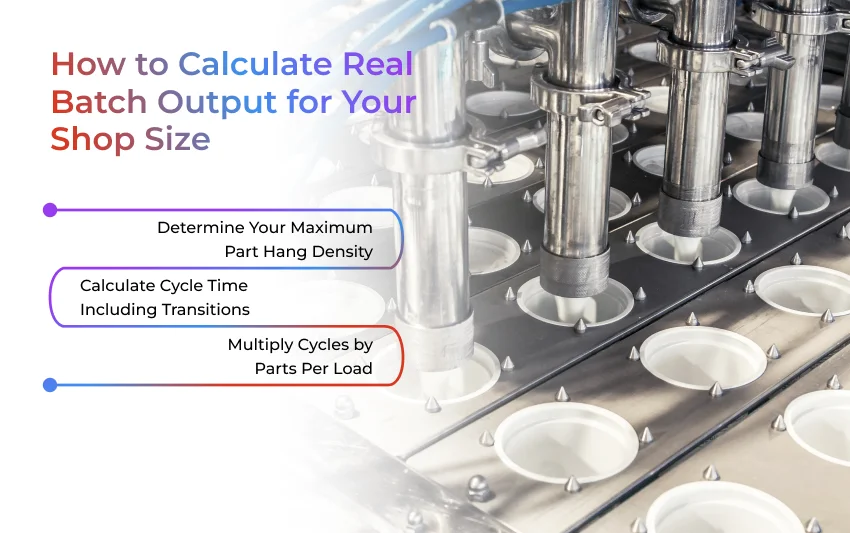
Production output calculation starts with oven interior dimensions and works backward through hang density, cure cycle time, and loading efficiency. Most shops significantly overestimate their theoretical output and underestimate the floor-to-cycle time that actually governs daily throughput.
Step 1: Determine Your Maximum Part Hang Density
Calculate the maximum number of parts that fit in a single oven load based on your typical part size and the hang spacing your oven dimensions allow. Parts need a minimum 2 to 3 inch clearance from each other for proper electrostatic spray coverage and heated air circulation during cure.
A 4 x 4 x 6-foot oven interior can theoretically hold more parts than most operators hang in production. Real hang density accounts for loading access, hook placement, and the practical limits of operators loading and unloading parts efficiently without damaging coated surfaces.
Step 2: Calculate Cycle Time Including Transitions
Total cycle time includes preheat dwell if required, ramp time to cure temperature, cure dwell time at PMT, cool-down to safe handling temperature, and load/unload time. Many shops undercount the last two items and project output 20 to 30 percent higher than the actual daily production achieved.
A standard cure cycle for most industrial powders at 375 degrees Fahrenheit runs 20 minutes. Add 10 to 15 minutes for the oven to recover to the set point after a cold load, 15 minutes for cool-down, and 10 minutes for load and unload. That's 55 to 60 minutes per cycle, not 20.
Step 3: Multiply Cycles by Parts Per Load
At 55 minutes per cycle, a single-door batch oven runs approximately 8 full cycles in an 8-hour shift. At 20 parts per load, that's 160 parts per shift. At 10 complex parts per load, that's 80 parts per shift. These are the numbers that determine whether your professional powder coating setup justifies adding a second oven.
Size the Right Oven for Your Part Volume
Call Creative Coating Solutions at (618) 741-0740 and we'll walk through the throughput math with you directly.
|
Faraday Cage Penetration and Complex Part Geometry
The Faraday cage effect is the most common application problem on recessed geometries, including box sections, channel profiles, and inside corners. Electrostatic spray lines follow the path of least resistance and terminate at the nearest ground point, leaving powder-thin or bare areas in cavities that face away from the gun.
Understanding Faraday cage behavior is essential for shops processing complex fabrications, automotive components, or architectural extrusions. Parts with deep recesses require specific gun settings, spray angles, and, in some cases, tribo application to achieve full coverage in problem zones.
The Powder Coating Institute recommends reducing kV output to 40 to 50 kV when penetrating Faraday cage areas on most geometries, counter-intuitively reducing voltage to improve penetration rather than increasing it. Higher kV concentrates lines of force at part edges and corners, worsening the problem.
Adjustable kV output is not optional for shops processing complex parts. A gun with a fixed 80 to 100 kV output cannot address Faraday cage problems regardless of how skilled the operator is. This is a specification that eliminates entire categories of production problems when present in the equipment.
Read More About: Powder Coating Equipment Explained: Ovens, Booths and Guns
Entry-Level vs Industrial Powder Coating Equipment
The performance gap between entry-level and industrial equipment is measurable in daily throughput, rework rates, and powder consumption. Entry-level gear is adequate for low-volume custom work. Industrial equipment is engineered for consistent production over extended daily operation cycles.
Entry-level guns use simpler electrode designs that deliver acceptable TE on straightforward parts but degrade on complex geometries. Their powder flow control is coarser, making consistent film thickness harder to maintain across an operator shift. Maintenance intervals are shorter, and consumable costs per part are higher.
Industrial guns have higher-grade electrical components, finer powder flow adjustment, more robust electrode designs, and longer maintenance intervals. They are calibrated for production shop use, where stopping to replace parts mid-shift is genuinely costly.
According to Products Finishing Magazine, shops that upgrade from entry-level to industrial-grade spray equipment see average rework rate reductions of 35 to 45 percent within the first sixty days of operation, with direct labor savings that typically offset equipment cost in under one year.
Reading Powder Coating Equipment Listings Critically
When evaluating equipment for sale listings, the specifications most relevant to production performance are temperature uniformity rating (not just maximum temperature), kV adjustment range (not just maximum kV), powder flow rate range in grams per minute, and oven interior dimensions with door opening clearance measurements.
Listings that provide only maximum temperature and voltage outputs tell you little about production performance. A gun rated to 100 kV with no adjustability is less versatile for production work than a gun rated to 80 kV with full programmable control across the output range.
Ask specifically whether oven temperature uniformity has been tested and documented, what internal fan CFM rating corresponds to the oven volume, and whether the unit has been used in production (versus hobby or low-cycle custom work). These questions separate equipment priced for its specs from equipment priced for its appearance.
Conclusion
The powder coating equipment specifications that actually drive production output are transfer efficiency, temperature uniformity, film thickness control, and kV adjustability for Faraday cage work. Buying on price or chamber size without examining these specs leads to underperforming setups that cost more to run than better-specified alternatives. Request a quote from Creative Coating Solutions and get expert guidance on the right equipment for your production needs.
FAQ
What transfer efficiency should I expect from powder coating guns?
Professional powder coating spray guns in production use achieve transfer efficiency (TE) between 65% and 85% on standard flat or cylindrical part geometries under controlled conditions. Entry-level guns with fixed spray patterns typically deliver 50 to 65% TE.
Is my oven's temperature uniformity causing cure issues?
Place calibrated thermocouples at the front, rear, top, middle, and bottom. Compare readings at your cure set point; variance above ±5 to 7°F indicates an airflow or element problem.
Faraday cage effect in powder coating: how to fix it?
A Faraday cage stops electrostatic lines from penetrating recesses. Reduce kV to 40 to 50 for recessed areas, angle the gun into cavities, or use tribo guns for severe geometries.
How much equipment to start a powder coating shop?
A functional powder coating shop needs five components: an adjustable-kV spray gun, a curing oven for your largest part, an enclosed booth with filtration, clean, dry compressed air, and a grounding system.
Target film thickness for industrial powder coating?
Most industrial powder coating applications target a dry film thickness (DFT) of 2.0 to 4.0 mils (50 to 100 microns) as a standard production window. Architectural aluminum applications often specify 2.0 to 3.0 mils per AAMA 2604 or 2605 standards.